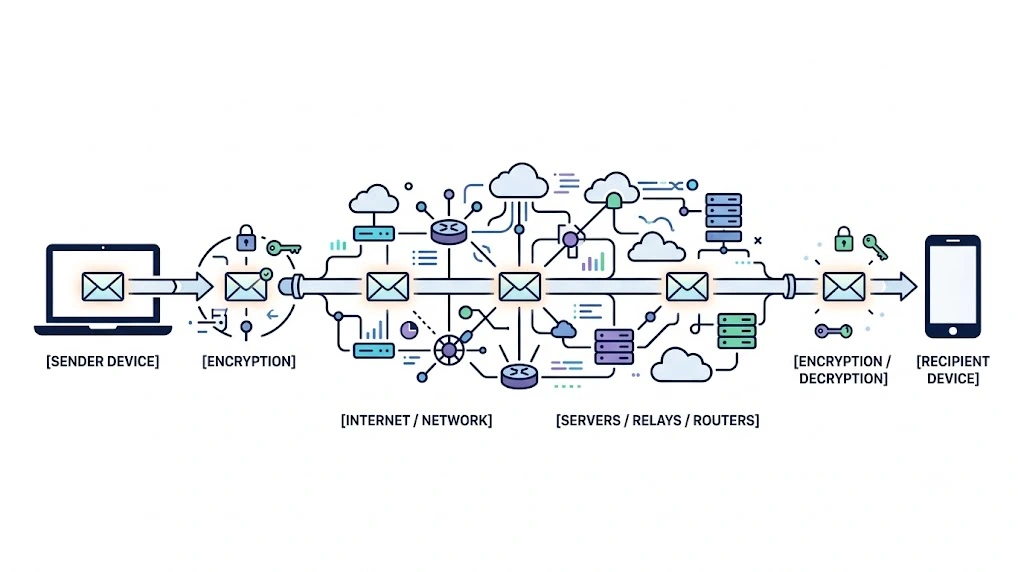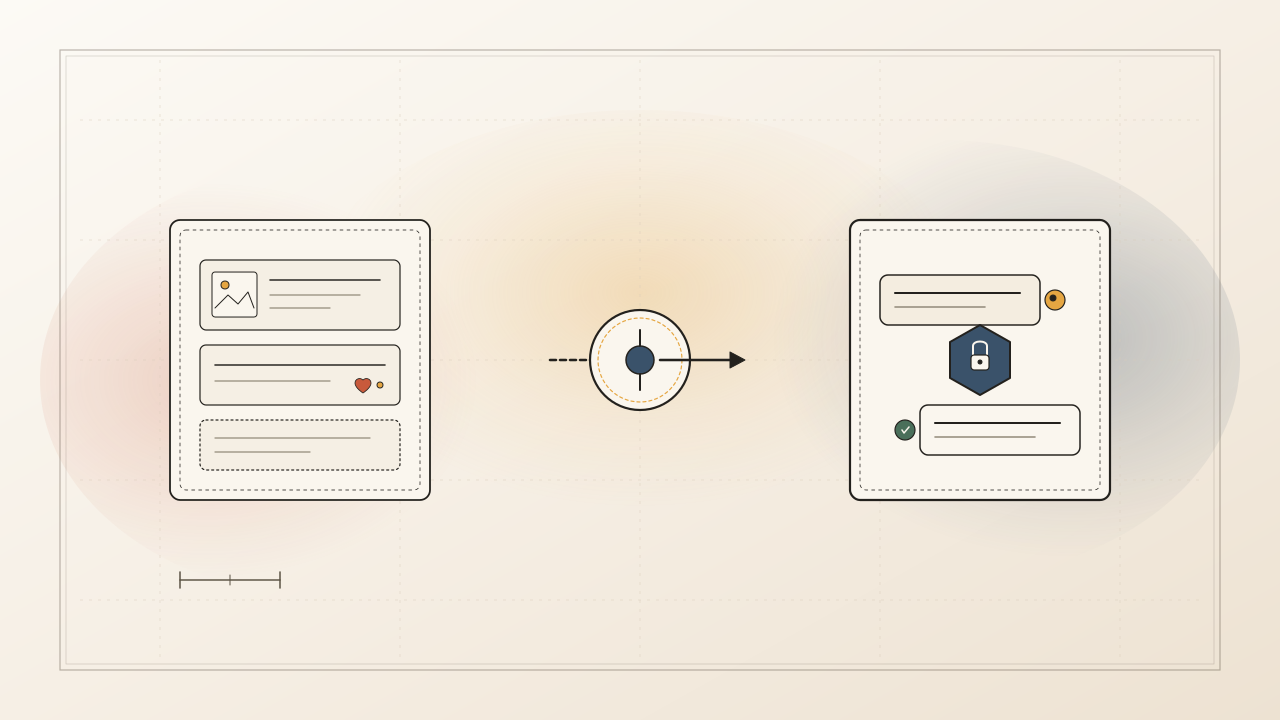
When we announced that Lupyd was moving away from social-media-style features to focus on private messaging, some assumed we were finally getting serious about privacy. The truth is quite different: we were always focused on privacy from day one, even when building social feeds. The real reason we stepped back from social media came down to clarity. Having a social feed alongside a private messaging suite confused new users, made pitching our product difficult, and blurred the direction of what we were building.
Privacy Was Always the Core (Even in Social)
Most social media platforms operate by harvesting user attention and behavioral telemetry. They log every pause, click, like, and search query to centralized servers to train advertising algorithms.
Lupyd never operated that way. Even in our earliest social feed prototypes, our entire architecture was designed around strict user privacy:
- Client-Side Recommendation Models: Rather than aggregating user data into massive cloud databases, our recommendation algorithms ran locally on user devices. User reading habits and thematic interests were converted into compact vector embeddings stored on your physical hardware.
- Zero-Knowledge Discovery: When fetching new posts, the application sent blinded vector similarity queries to public indexes without attaching user identity tokens or tracking cookies.
- Anonymous Interactions: Using cryptographic blind signatures (via our open-source NOON library), users could like or interact with posts without servers discovering who submitted which reaction.
Privacy was never an afterthought or a pivot for us. It was the engineering foundation of every feature we designed.
The Positioning Dilemma: Confusion for New Users
If privacy was already intact, why did we decide to step back from social media?
The issue was not the technology. It was user comprehension and product positioning.
When someone downloaded Lupyd or visited our website, they were confronted with two entirely different modes of interaction living in the exact same application:
Public Social Experience
Discovery, Feeds, and Community
Browse posts, follow content creators, share public articles, and explore topics using on-device recommendation algorithms.
Confidential Team Messaging
End-to-End Encrypted Group Chat
Sovereign team channels, encrypted direct messages, MLS TreeKEM ratcheting, and zero-knowledge packet relays for work and private coordination.
New users immediately asked: "What is Lupyd? Is it a private Twitter alternative? Or is it a secure alternative to Slack and Signal?"
When an app attempts to be both a public broadcast platform and a confidential workplace, it ends up serving neither group well. Teams handling proprietary code, legal negotiations, and confidential company operations felt uncomfortable using an app that had a social feed tab. Meanwhile, people looking for social discussions were confused by cryptographic key verifications and team workspace settings.
Why Pitching Two Products Blurred Our Direction
This confusion became even more pronounced whenever we pitched Lupyd to teams, partners, and the broader tech community.
In product development, clarity of message is everything. If you cannot explain what your product does in a single, unambiguous sentence, the burden falls on the user to figure it out. Most users simply move on.
When we pitched Lupyd as a private social network, people evaluated us against Twitter, Threads, and Bluesky. When we pitched Lupyd as a zero-knowledge communication suite, people evaluated us against Slack, Discord, Matrix, and Signal. Trying to pitch both under a single umbrella diluted our value proposition and gave people the impression that we lacked a clear direction.
We realized that by trying to build two ambitious platforms in one interface, we were making it harder for users to trust either one.
Mixed Direction (Confusing to Pitch)
Focused Direction (Clear Positioning)
The Decision to Focus: Private, Sovereign Messaging
To give Lupyd the sharp, unmistakable identity it deserves, we made the conscious choice to step back from social media features and channel our full energy into private communication.
This focus allows our engineering team to concentrate entirely on what matters most for secure communication:
- IETF MLS Protocol Engineering: Perfecting our Firefly engine with TreeKEM group ratchets for instant multi-device synchronization and verifiable forward secrecy.
- Custom Cryptographic Role Management: Embedding channel permissions directly into client-ratcheted MLS tree states so server operators cannot manipulate roles.
- Zero-Knowledge Relays: Operating lightweight, stateless relays that route ciphertexts blindly without retaining conversation graphs or room DAGs.
- Decentralization Roadmap: Building federated, sovereign communication nodes (tracked on our public roadmap at about.lupyd.com/roadmap).
Today, when someone asks what Lupyd is, the answer is crystal clear: Lupyd is a sovereign, zero-knowledge messaging platform built for teams and individuals who need mathematically guaranteed privacy.
Will Social Features Return? Future Standalone or Re-Introduction
Pausing our social feed inside Lupyd does not mean we abandoned the research or the technology behind it.
We spent months developing privacy-preserving recommendation models, client-side vector ranking algorithms, and cryptographic blind-voting schemes. That technology remains fully functional and deeply compelling.
As the digital landscape evolves and users grow increasingly fatigued by toxic, surveillance-driven social media algorithms, there may come a time when people catch up to the need for a truly private, on-device social discovery platform.
If and when that happens, we may re-introduce these features. However, we have learned our lesson about product clarity: if we bring social curation back, we will likely do so as a separate, standalone application with its own brand, dedicated audience, and clean value proposition.
For now, our mission with Lupyd is singular and focused: building the safest, most dependable private messaging engine in the world.
Explore Lupyd's Private Messaging Engine
Learn how our open-source Firefly engine and MLS protocol protect team conversations.
- ✓ Lupyd was always focused on privacy from day one, including in our social features which ran on private, client-side recommendation algorithms.
- ✓ Offering both a social feed and private messaging created confusion for new users about what Lupyd was actually built to do.
- ✓ When pitching Lupyd to new users and teams, having two different product models under one roof blurred our identity and core value proposition.
- ✓ We stepped back from social media to establish an unambiguous direction centered on private team chat and sovereign communication.
- ✓ Our client-side recommendation technology remains intact; we may re-introduce it in the future as users catch up, or launch it as a separate dedicated app.