Internal Communication Threat Surface & Zero-Knowledge Defense
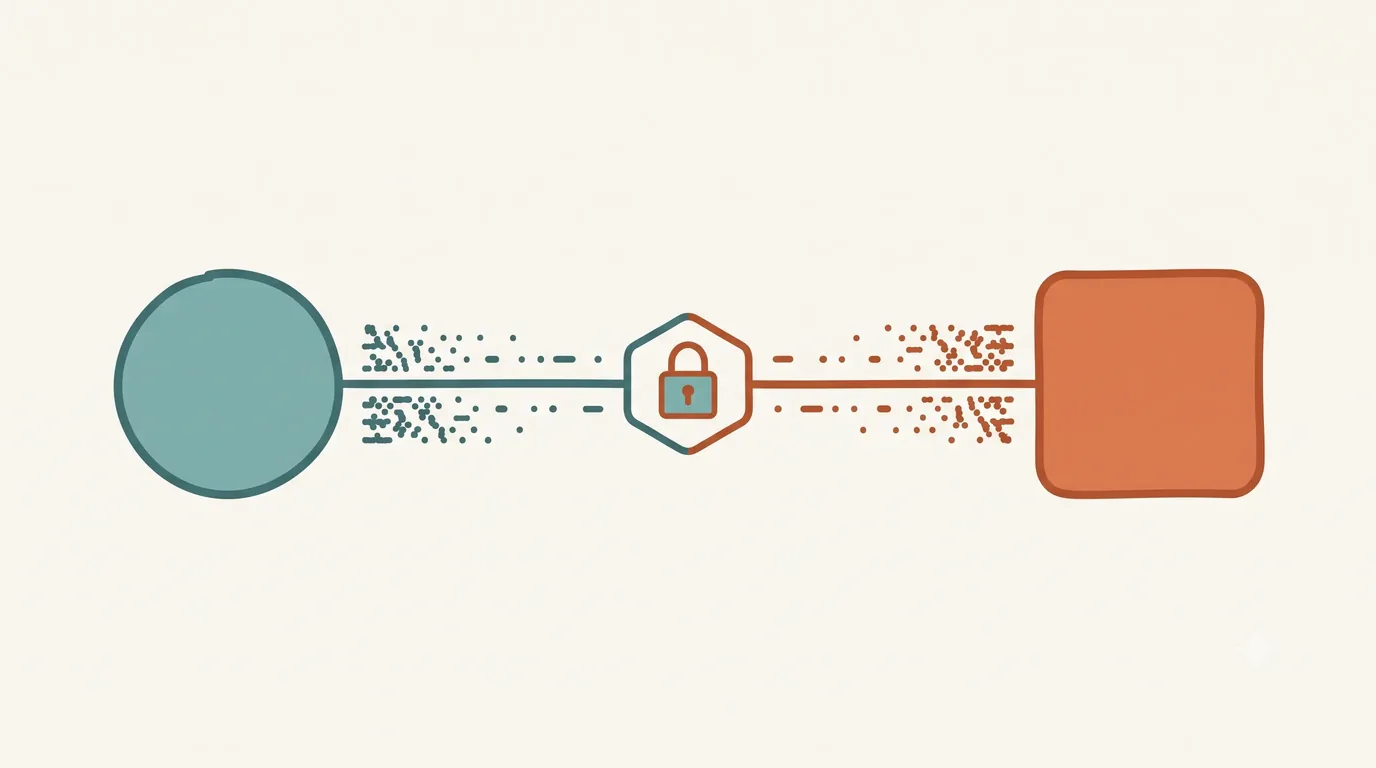
Message Payload
Untrusted Relay / ISP
Zero-Knowledge E2EE
Comparing legacy cloud message inspection against zero-knowledge cryptographic endpoint boundaries for business conversations.
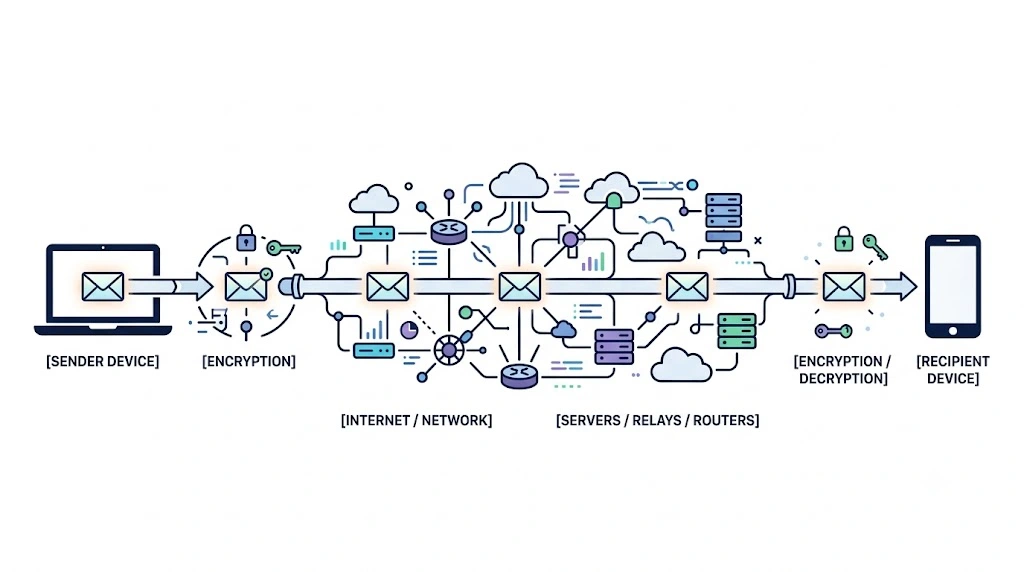
Zero-Knowledge Business Messaging Flow
Local Key Derivation
Unreadable to Couriers
✓ Authenticated
Conversations and documents are encrypted directly on employee devices before reaching intermediate network couriers.
Businesses communicate every single day through messaging apps, group chats, email, and collaboration platforms. These real-time conversations carry the lifeblood of an organization: customer records, unreleased product roadmaps, strategic project plans, financial models, executive board discussions, and other strictly confidential data. As remote and digital-first work continues to expand, secure internal communication has transformed from an IT afterthought into the fundamental cornerstone of modern enterprise data defense.
What Is Secure Internal Communication?
At its core, secure internal communication means protecting messages, voice calls, shared files, and collaborative conversations between employees from unauthorized access, interception, insider tampering, or third-party exposure. It establishes a trusted, resilient digital environment where teams can exchange mission-critical thoughts without fear of espionage, credential leakage, or vendor surveillance.
A complete secure internal communication framework encompasses five vital operational layers:
Secure Team Messaging
Encrypted bilateral channels and 1-on-1 direct messages engineered so only the intended sender and recipient possess cryptographic decryption keys.
Secure Group Communication
Multi-user project channels and department rooms fortified with cryptographic forward secrecy and post-compromise security as members join and leave.
Protected File & Asset Sharing
End-to-end scrambled document transfers, code snippets, financial spreadsheets, and media attachments that remain opaque ciphertext while in transit and at rest.
Private Executive Conversations
Ephemerally ratcheted rooms for board meetings, HR grievance reviews, mergers and acquisitions (M&A), and confidential corporate strategy.
True secure internal communication is far more than an HTTPS lock icon in a browser tab. While transport encryption protects data between an employee's laptop and an application server, standard cloud services immediately decrypt that data into plaintext in backend memory. A truly secure architecture enforces zero-knowledge boundaries where intermediate servers operate strictly as blind couriers.
5 Reasons Why Secure Internal Communication Is Critical
Why have cybersecurity specialists and executive teams placed encrypted internal communication at the forefront of their defensive roadmaps? Because the operational surface of modern business is defined not by physical office perimeters, but by continuous chat streams.
🔐 1. Protect Confidential Information
Every working day, employees routinely paste proprietary code, discuss unannounced patents, analyze customer quarterly churn, share investor updates, and debate pricing models. If a communication tool stores conversations in readable database records, that intellectual property is perpetually vulnerable.
When businesses enforce end-to-end encrypted team messaging, trade secrets remain strictly contained within authenticated corporate endpoints. Even if an adversary intercepts network traffic or gains unauthorized access to cloud hosting clusters, they encounter only unreadable ciphertext envelopes without mathematical access to session keys.
👥 2. Protect Team Conversations
Group chats and department channels are where actual decision-making happens. Engineering teams coordinate incident responses, sales teams brainstorm proposal concessions, and legal departments draft liability disclosures.
Unlike public social networks, internal workplace discussions require absolute candidness. If staff fear that conversations are indexed for keyword tracking, aggregated for third-party machine learning training, or accessible to curious database administrators, creative collaboration suffers. Secure internal communication guarantees that team brainstorms and sensitive assessments remain private to authorized participants.
🌐 3. Support Remote and Distributed Teams
The rapid rise of remote, hybrid, and international distributed teams has dismantled the traditional corporate firewall. Employees connect from home fiber connections, co-working hubs, airport Wi-Fi hotspots, and personal mobile devices across different jurisdictions.
Legacy VPNs and centralized network gateways are notoriously clumsy, often slowing down voice calls and introducing single-point-of-failure choke points. A modern, secure internal communication platform provides built-in cryptographic protection that travels with the user, regardless of network location. Whether an engineer messages from Tokyo or New York, the security of their communication is enforced mathematically at the application layer.
In a zero-trust security model, the network is always assumed to be hostile. Secure internal communication operates on the principle that no intermediate router, internet provider, or cloud relay can be inherently trusted. By placing cryptographic keys exclusively in physical device hardware, companies ensure zero-trust compliance across every remote interaction.
📁 4. Protect Business Data and Shared Files
Communication tools are rarely limited to text; they are dynamic file transfer pipelines. PDF contracts, employee tax forms, pitch decks, server private keys (.pem files), and architecture diagrams are casually dropped into channels every hour.
When evaluating software, businesses must ask: Where do uploaded files live, and who holds the keys? Standard collaboration suites store uploaded files in centralized cloud buckets with server-side keys managed by the vendor. In contrast, secure internal communication mandates client-side payload encryption prior to upload, preventing file scrapers and cloud misconfigurations from exposing sensitive business data.
🔒 5. Reduce Unauthorized Access and Insider Exposure
Data breaches frequently originate from credential harvesting, phishing, or rogue insiders abusing administrative permissions. In traditional collaboration software, an administrator or compromised service token can quietly run an organization-wide search across years of historical chat logs.
Zero-knowledge internal messaging dramatically shrinks this blast radius:
- Elimination of Server Plaintext: Because relays never receive decryption keys, a cloud breach yields no legible communications.
- Forward Secrecy: Temporary ratcheting keys are continually erased from device memory. If a device is stolen today, past historical messages cannot be decrypted.
- Cryptographic Device Verification: New employee devices must be cryptographically attested and authorized by existing session members, preventing phantom listeners from silently joining private channels.
What Businesses Should Look for in a Secure Platform
With virtually every software vendor claiming "enterprise-grade security," how can IT directors, CISOs, and business owners distinguish genuine protection from clever marketing? When evaluating a secure messaging platform for business, use this architectural evaluation checklist:
| Security Evaluation Area | Legacy Cloud Collaboration | Zero-Knowledge Architecture |
|---|---|---|
| Encryption Scope | TLS in transit; decrypted on server memory | Continuous end-to-end encryption (E2EE) |
| Key Custody | Managed by cloud vendor or cloud KMS | Physical user devices only; zero vendor access |
| Group Ratcheting | Server database permissions check | IETF Messaging Layer Security (MLS TreeKEM) |
| Metadata Minimization | Extensive persistent activity & social graphs | Ephemeral routing packets, purged upon delivery |
| Search Indexing | Centralized cloud databases (ElasticSearch) | Encrypted on-device client indexing |
| Subpoena & Breach Risk | Readable plaintext can be subpoenaed or leaked | Zero plaintext stored; mathematically unextractable |
Beyond cryptographic algorithms, companies must inspect account governance: Does the platform require invasive phone number verification, or does it support sovereign cryptographic identities? Can permissions be enforced by mathematical consensus rather than vulnerable administrative portals?
How Lupyd Fits In: Sovereign Architecture
At Lupyd, we built our platform upon a fundamental realization: for businesses, secure communication is not merely about launching another chat app; it is about guaranteeing absolute data ownership and mathematical protection for every byte of information shared through it.
Lupyd focuses on privacy, zero-knowledge security, verifiable encryption, and sovereign data ownership. Our engineering foundation includes:
- Secure Pairwise & Group Communication: Powered by the open IETF Messaging Layer Security (MLS, RFC 9420) standard and the Firefly encrypted messaging engine, Lupyd delivers effortless group scalability with instantaneous epoch ratcheting whenever members join or depart.
- Blind Relay Network: Lupyd servers operate strictly as blind couriers. Intermediate routing nodes receive opaque encrypted payloads and have neither the cryptographic keys nor the technical capability to decrypt conversation content.
- Protected Voice and Calling: Real-time WebRTC audio and video streams protected with end-to-end cryptographic keys, ensuring executive strategy sessions remain completely confidential.
- On-Device Local Discovery: Search indexing happens directly on employee laptops and phones, eliminating central plaintext databases that attract external threat actors.
- Open Cryptographic Transparency: Unlike proprietary black-box systems, our cryptographic foundations and client libraries are open source, allowing enterprise security teams and independent researchers to audit our protocols directly.
Final Thoughts: Moving Beyond 'How We Communicate'
As global enterprises migrate deeper into digital operations and remote workforces disperse across continents, communication platforms have become the central nervous system of modern business.
Relying on legacy tools that treat privacy as an afterthought or an optional corporate policy is a risk no forward-looking organization can afford. A truly secure internal communication platform safeguards confidential strategies, protects team brainstorming, protects company data assets, and shields distributed employees while keeping everyone seamlessly connected.
The central question for modern business leaders is no longer simply: “How do we communicate?”
It is: “How do we communicate while mathematically protecting the information we share?”
By implementing zero-knowledge, end-to-end encrypted messaging designed for enterprise privacy, businesses reclaim sovereignty over their conversations, protect their competitive edge, and build a resilient foundation for the digital future.
- ✓ Internal team communication channels carry high-value enterprise assets: product roadmaps, financial forecasts, customer PII, credentials, and legal strategies.
- ✓ Standard transport encryption (TLS) leaves messages readable on cloud vendor infrastructure, creating persistent exposure to subpoenas, vendor breaches, and rogue administrator access.
- ✓ Distributed and remote work models eliminate traditional network perimeters, making device-to-device zero-knowledge cryptographic boundaries essential.
- ✓ Effective internal communication security spans five operational pillars: confidential information defense, team conversation privacy, remote team support, file protection, and unauthorized access mitigation.
- ✓ When evaluating secure messaging platforms, organizations must prioritize client-side key custody, scalable group ratcheting (MLS), and metadata minimization over marketing claims.
- ✓ Lupyd replaces corporate 'trust us' policies with verifiable zero-knowledge encryption, ensuring businesses communicate freely without exposing internal data.