Client-Server Cloud Encryption vs True Zero-Knowledge E2EE
Message Body
No Plaintext Access
Checks epoch monotonic counter and forwards packet.
Decryption & Check
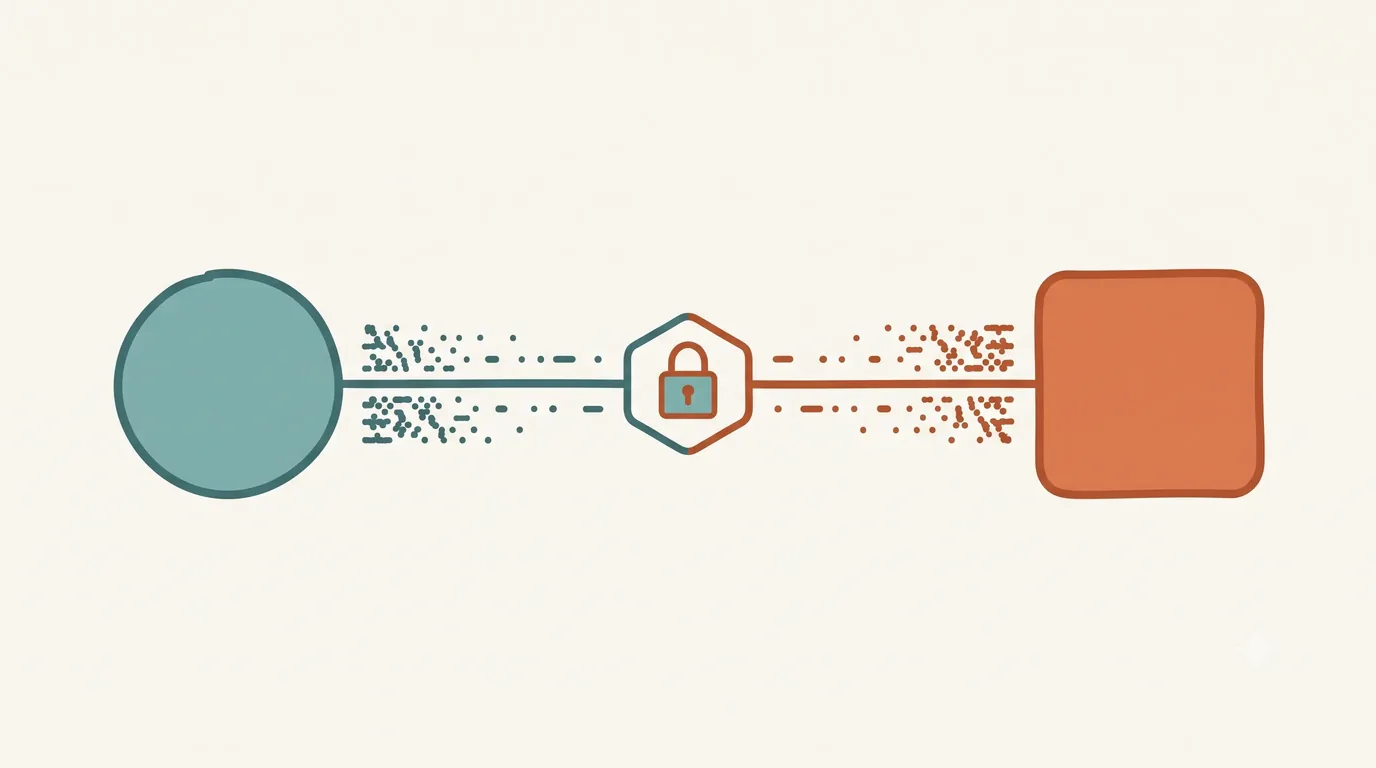
Comparing intermediate cloud server plaintext inspection against end-to-end encrypted endpoint boundaries.
End-to-End Encryption Message Lifecycle
Local Key Derivation
Unreadable to Couriers
✓ Authenticated
How cryptographic keys stay exclusively on physical endpoints while intermediate relays operate blindly.
If you ask whether Telegram is encrypted, the answer is an unequivocal yes. But if you ask whether Telegram is end-to-end encrypted by default, the answer is fundamentally different. That technical distinction carries profound consequences for personal privacy, workplace security, and corporate compliance.
Telegram employs robust encryption across its global infrastructure. However, its default Cloud Chats are not end-to-end encrypted. Telegram's separate, opt-in Secret Chats use client-to-client encryption, but operate under an entirely different architecture. When messaging applications are used to share customer records, intellectual property, contracts, executive decisions, or sensitive files, misunderstanding this distinction creates serious security blind spots.
The Short Answer: Is Telegram End-to-End Encrypted?
Telegram is encrypted, but its regular chats are not end-to-end encrypted.
Telegram splits its messaging ecosystem into two distinct conversation types:
The standard messaging system for all private 1-on-1 chats, group chats, and channels. Uses client-server / server-client encryption. Messages are stored on Telegram's cloud servers, enabling seamless multi-device synchronization.
A specialized end-to-end encrypted mode that must be manually launched per contact. Uses device-to-device encryption. Messages are not stored in the Telegram Cloud and cannot sync across multiple devices.
The golden rule of cryptographic security: "Encrypted" does not automatically mean "end-to-end encrypted."
What Does End-to-End Encryption Actually Mean?
To evaluate Telegram accurately, it is essential to distinguish encryption in transit from genuine end-to-end encryption (E2EE).
1. Encryption in Transit (Client-Server-Client)
Encryption in transit protects information as it travels over the public internet between your device and the vendor's server:
In this model, the intermediate server decrypts the payload into memory to index it, search it, and replicate it to databases. The cloud provider holds technical decryption capability.
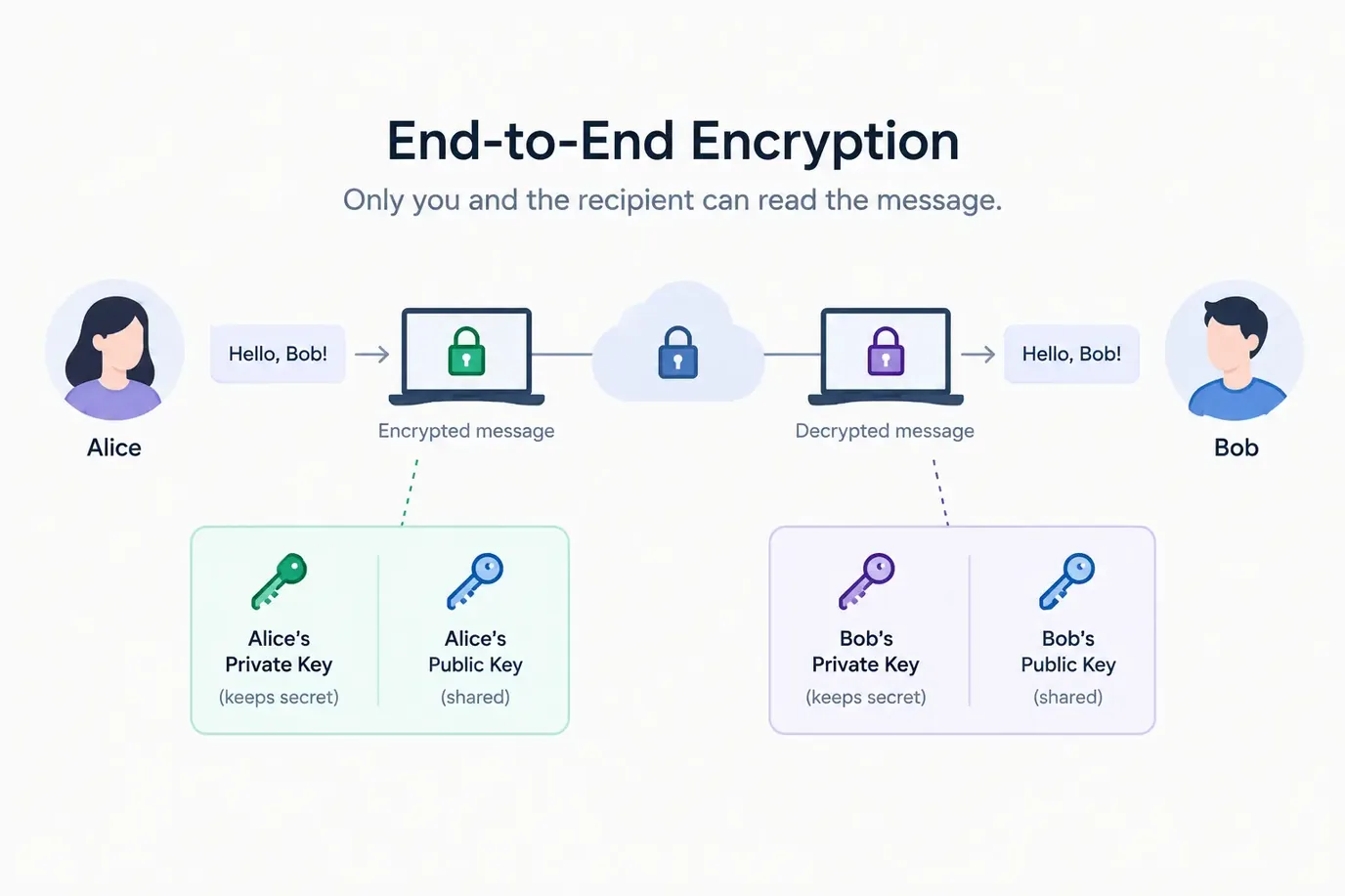
2. End-to-End Encryption (Zero-Knowledge E2EE)
With genuine E2EE, the message is encrypted on the sender's physical hardware and can only be decrypted on the recipient's authenticated hardware:
The server acts purely as a blind courier. Decryption keys never touch the relay. Even if the server infrastructure is compromised or compelled by government subpoenas, readable message content cannot be extracted.
The Critical Question
When evaluating any messaging tool, never just ask: “Is the message encrypted?”
Always ask: “Who holds the cryptographic keys, and who can decrypt the message?”
How Telegram's Two Chat Models Work: Cloud Chats vs Secret Chats
1. Telegram Cloud Chats
Cloud Chats represent over 99% of conversations on Telegram. They deliver exceptional convenience: instant search across years of history, gigabyte file sharing, seamless desktop and web clients, and effortless synchronization across multiple phones and tablets.
However, to provide instant cloud sync and search, Telegram's servers must be able to index and store messages. Telegram states that data is distributed across multiple global datacenters with keys separated across jurisdictions. While this prevents trivial local breaches, it remains an architectural trust model, not a mathematical zero-knowledge guarantee.
2. Telegram Secret Chats
Telegram Secret Chats utilize end-to-end encryption based on Telegram's proprietary MTProto protocol. In Secret Chats:
- Keys are negotiated directly between the two participating devices via Diffie-Hellman key exchange.
- Messages do not route through cloud sync storage.
- Optional self-destruct timers delete messages from both endpoints.
- Forwarding messages is blocked, and screenshot notifications are triggered on supported operating systems.
The Tradeoff: Secret Chats are device-bound. If you start a Secret Chat on your mobile phone, it does not exist on your laptop or tablet. Crucially, they are strictly bilateral (1-on-1) and cannot be enabled for groups.
Are Telegram Group Chats End-to-End Encrypted?
No. Telegram group chats are never end-to-end encrypted.
Telegram's official documentation and technical FAQs confirm that all group chats (which support up to 200,000 members) and broadcast channels are Cloud Chats. Telegram does not offer Secret Chats for groups.
For businesses and professional teams, this is a monumental consideration. Internal project channels, executive brainstorming groups, customer support channels, and engineering rooms on Telegram reside in readable form on Telegram's servers. If your organization discusses proprietary code, financials, or sensitive employee data in a Telegram group, that data is subject to server-side custody.
The Biggest Telegram Encryption Myth
“Telegram is encrypted, so everything I send on Telegram is private and end-to-end encrypted.”
Reality: Telegram is encrypted in transit and at rest in the cloud, but only manually initiated 1-on-1 Secret Chats are end-to-end encrypted. Default chats and all group chats can technically be accessed by whoever controls the server infrastructure or decryption keys.
Is Telegram Unsafe? Understanding Architectural Tradeoffs
Telegram is not inherently "unsafe"; rather, it is designed for a specific set of priorities: massive scalability, public communities, bot ecosystems, and seamless multi-device cloud accessibility.
Building an app that can sync 200,000-member groups, stream large media files, and maintain years of instant history across five devices simultaneously requires server-assisted architecture. End-to-end encryption places heavy constraints on server processing: servers cannot generate previews, cannot run server-side search indexes, and cannot easily fan out messages without complex cryptographic ratchets.
The key takeaway is fitness for purpose: Telegram excels at public broadcasts and casual community chat, but is fundamentally mismatched for confidential enterprise communication.
What About Telegram's Open-Source Claims?
Telegram frequently advertises that it is "open source." While this is true for client applications, it does not apply to the server backend:
- Client Code (Open Source): Telegram publishes source code for its iOS, Android, and Desktop apps, allowing verifiable reproducible builds.
- Server Code (Closed & Proprietary): Telegram has never published the backend server code that routes, stores, and manages Cloud Chats.
Because the backend is a closed proprietary system, independent security auditors cannot verify how Telegram's cloud handles encryption keys, where messages are routed, or whether access logs are retained.
What About Metadata and Server-Side Logging?
Encryption secures message text, but conversational metadata often reveals just as much about your organization. Telegram's published privacy policies state that it collects:
- IP addresses and connection timestamps.
- Device identifiers, operating system versions, and Telegram app editions.
- Contact address books (when permission is granted).
- Username changes and group membership histories.
In high-security and corporate threat models, metadata analysis allows adversaries to map corporate hierarchies, identify communication frequency, and deduce strategic partnerships even without reading message bodies.
Why Encryption Architecture Matters for Businesses
While individual users may prioritize animated stickers and giant public channels, organizations operate under legal, financial, and regulatory responsibilities.
When an enterprise uses messaging software, sensitive data surfaces everywhere:
- Customer personally identifiable information (PII) subject to data protection acts (such as India's DPDP Act, GDPR, or CCPA).
- Financial projections, investor correspondence, and bank account numbers.
- Source code snippets, server API keys, and deployment credentials.
- Legal strategy discussions and employee personnel records.
Relying on cloud-decrypted platforms exposes organizations to three major threat vectors: cloud provider data breaches, rogue vendor insider abuse, and secret legal subpoenas that compel vendors to provide readable transcripts without notifying the customer.
Why Group Encryption Matters: The MLS Standard
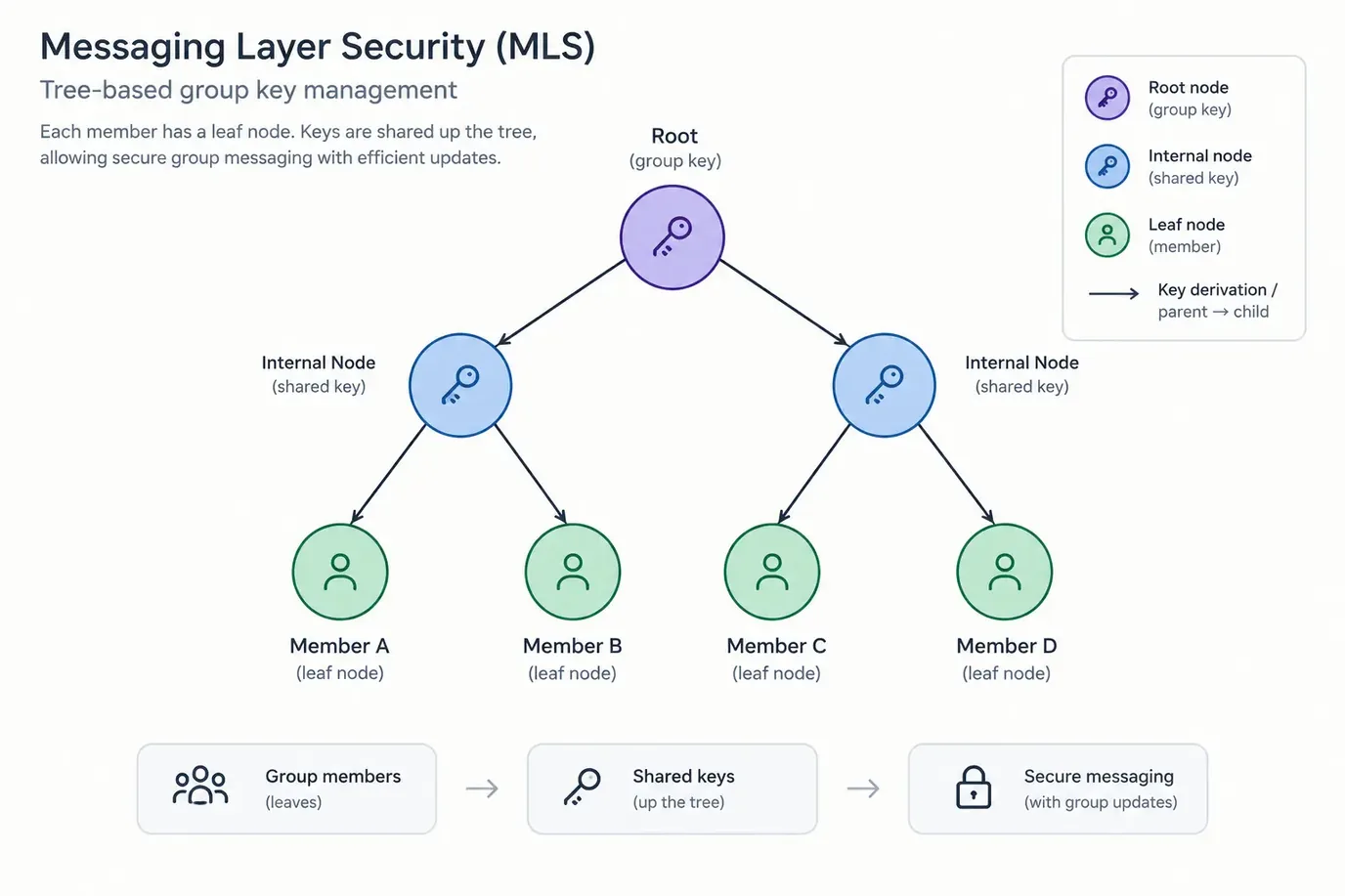
For years, technology companies claimed that multi-device, end-to-end encrypted group chat was mathematically too complex to deliver at scale. Pairwise double-ratchet protocols (like legacy Signal pairwise sessions) suffered from severe bandwidth fanout: sending a message to a 100-person group required encrypting and transmitting 100 separate payloads.
Modern cryptography solved this bottleneck with the IETF Messaging Layer Security (MLS / RFC 9420) standard. By using TreeKEM tree ratchets, MLS scales group cryptographic operations logarithmically (O(log N)). When an employee leaves a company group, the group epoch immediately ratchets forward, mathematically revoking their decryption capability without requiring full network re-keying storms.
Telegram vs Privacy-Focused Business Messaging: Comparison
| Architectural Dimension | Telegram Cloud Chats | Telegram Secret Chats | Lupyd (Default Architecture) |
|---|---|---|---|
| End-to-End Encryption | ❌ No (Client-Server) | ✅ Yes (1:1 only) | ✅ Yes (Always On Default) |
| Group Chat E2EE | ❌ No E2EE in groups | ❌ Not supported | ✅ Yes (IETF MLS TreeKEM) |
| Multi-Device Sync | ✅ Cloud server sync | ❌ Device-locked only | ✅ Cryptographic Multi-Device |
| Key Custody | Telegram servers hold keys | User endpoints only | User endpoints only (Zero Vendor Keys) |
| Server Visibility | Plaintext readable on servers | Ciphertext relay | Blind Relays (Zero Plaintext Stored) |
| Server Code | Closed / Proprietary | Closed / Proprietary | Open Cryptographic Suite |
| Search Indexing | Cloud server search | Local device search | On-Device Local Discovery |
Where Lupyd Fits: Default Zero-Knowledge Architecture
Lupyd was created to eliminate the compromise between convenience and mathematical confidentiality.
Rather than relegating end-to-end encryption to an opt-in, device-locked sub-feature, Lupyd builds privacy into every layer of its communication protocol:
- Zero-Knowledge E2EE by Default: All direct messages, group channels, voice calls, and file transfers are encrypted endpoint-to-endpoint. There are no "unencrypted cloud modes."
- IETF MLS Group Protocol: Team channels ratchet forward with true post-compromise security and backward secrecy, allowing scalable team rooms without compromising cryptographic integrity.
- Blind Relays: Intermediate Lupyd servers act strictly as blind packet couriers. They route opaque binary envelopes without possessing decryption keys.
- On-Device Local Discovery: Search indexing happens directly on employee hardware, eliminating centralized searchable honeypots.
- Open Protocol Transparency: Lupyd's core cryptographic engine, Firefly, is open-source and auditable on GitHub.
What Businesses Should Look for in a Secure Messaging Platform
Before standardizing on a messaging app for team communication, evaluate these 10 criteria:
- Default E2EE: Is encryption turned on automatically without requiring employees to toggle special settings?
- End-to-End Group Security: Are multi-user project channels protected with modern group ratchets?
- Key Sovereignty: Does your organization or employee hardware hold exclusive custody of private keys?
- Blind Server Infrastructure: Does the vendor have zero mathematical ability to decrypt conversation payloads?
- Granular Eviction: Can former team members be cryptographically evicted the moment they depart?
- Metadata Minimization: Are routing envelopes purged immediately after delivery?
- Verifiable Codebase: Are cryptographic primitives open for public inspection and third-party audit?
- Local-First Search: Does keyword search execute on-device rather than querying cloud databases?
- Regulatory Alignment: Does the platform satisfy statutory obligations under frameworks like India's DPDP Act and GDPR?
- Shadow IT Defense: Does the platform provide an intuitive user experience so teams do not circumvent security for consumer apps?
Frequently Asked Questions
Is Telegram end-to-end encrypted by default?
No. Telegram Cloud Chats (which include all standard 1-on-1 chats and all group chats) use client-server encryption, not end-to-end encryption. Only Telegram Secret Chats are end-to-end encrypted.
Are Telegram group chats end-to-end encrypted?
No. All Telegram group chats are Cloud Chats. Telegram does not support Secret Chats for groups, meaning group conversations are stored on Telegram servers with server-managed keys.
Can Telegram Secret Chats sync across multiple devices?
No. Secret Chats are device-bound. They are stored only on the specific physical hardware where they were initiated and do not sync to Telegram Desktop, Web, or secondary mobile devices.
Can Telegram read Cloud Chat messages?
Because Cloud Chats are decrypted on server memory to power search and synchronization, Telegram has technical decryption capability over message contents, unlike in zero-knowledge E2EE architectures.
Is Telegram open source?
Telegram's client apps are open source, but its server-side backend code is closed and proprietary.
How does Lupyd differ from Telegram?
Lupyd is zero-knowledge and end-to-end encrypted by default across all 1-on-1 chats, group channels, calls, and files using IETF MLS (RFC 9420). Intermediate servers never hold keys and cannot read messages.
Final Takeaway
The words “encrypted” and “end-to-end encrypted” describe two completely different worlds of digital security.
Telegram demonstrates why understanding this difference is essential. Its default Cloud Chats deliver remarkable multi-device convenience, while its Secret Chats offer a separate, device-restricted E2EE mode.
For casual public channels and social chats, that tradeoff may be acceptable. But for businesses, startups, legal practices, healthcare teams, and privacy-conscious professionals handling proprietary information, leaving group conversations in server-readable cloud storage is an avoidable liability.
Don't just ask whether your messages are encrypted.
Ask who can decrypt them, who can access them, and how your communication is protected.
Explore Lupyd to experience private, sovereign, zero-knowledge team communication built for the modern enterprise.
- ✓ Telegram encrypts all data, but its default Cloud Chats are NOT end-to-end encrypted; they use client-server encryption where Telegram servers hold decryption keys.
- ✓ Secret Chats are Telegram's only end-to-end encrypted mode, but they must be manually initiated, work only 1-on-1, and are restricted to a single device without cloud backup.
- ✓ All Telegram group chats and channels—regardless of size or member count—are Cloud Chats and lack end-to-end encryption.
- ✓ Telegram's client applications are open source, but its server-side backend code remains closed and proprietary, preventing independent verification of server data handling.
- ✓ Metadata including IP addresses, connection timestamps, device identifiers, and contact activity graphs are collected on Telegram servers under its privacy policy.
- ✓ Lupyd enforces continuous zero-knowledge end-to-end encryption across all direct messages and multi-user groups by default using the IETF Messaging Layer Security (MLS) protocol.