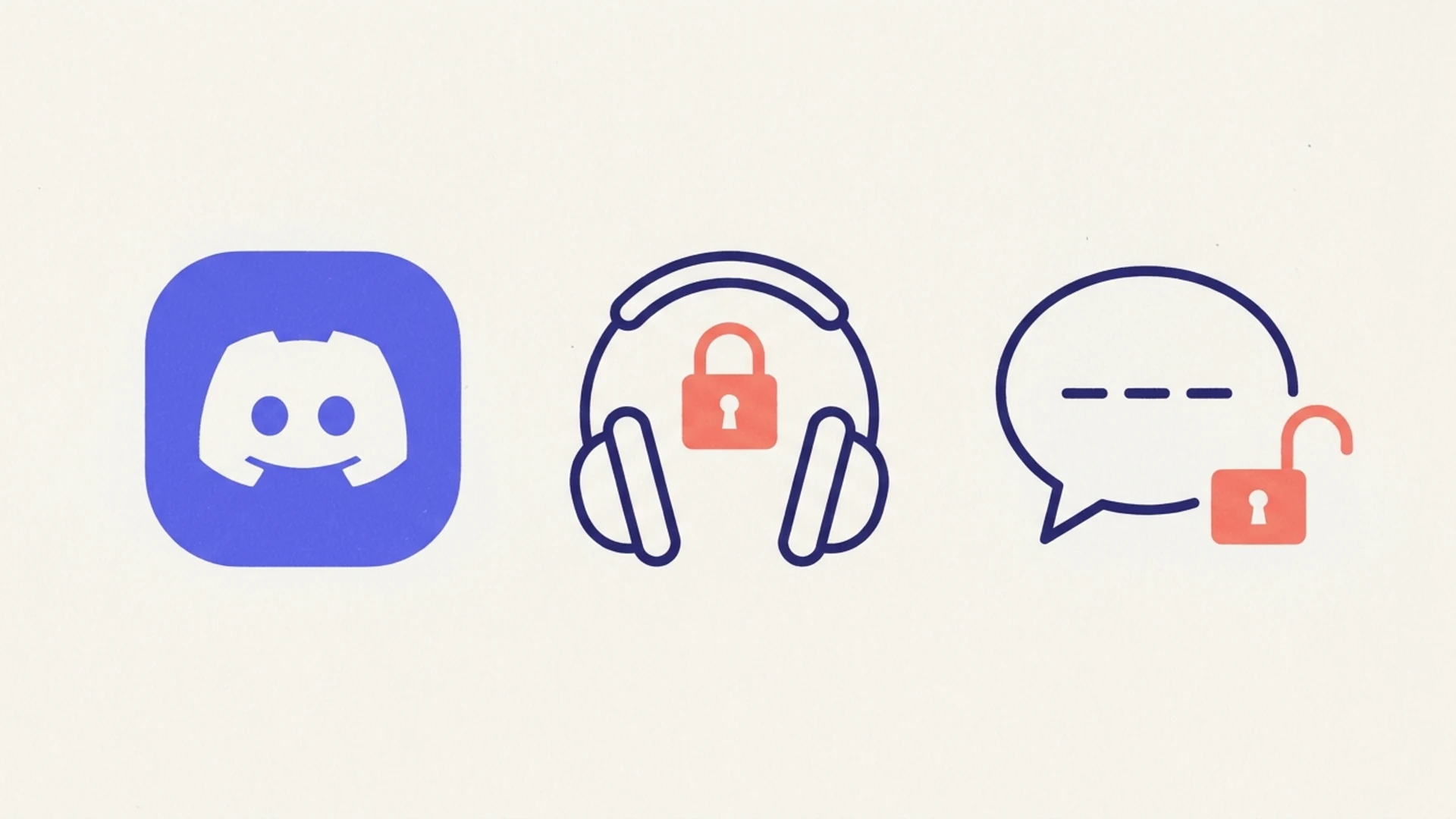
Only for calls. Since the beginning of March 2026, every voice and video call on Discord (DMs, group DMs, server voice channels and Go Live streams) is end-to-end encrypted by default with Discord's DAVE protocol, and you can't turn it off. Stage channels are the exception. Text messages, DMs, attachments and voice messages are not end-to-end encrypted, and Discord says it has "no current plans" to change that.
| Discord feature | End-to-end encrypted? |
|---|---|
| Text messages in server channels | No: TLS in transit and encrypted at rest, but Discord can read and scan them |
| Direct messages and group DMs (text) | No: same as server channels |
| Attachments, images and voice messages | No: stored by Discord, which says it proactively scans attachments |
| Voice and video calls in DMs and group DMs | Yes: DAVE protocol, on by default, can't be turned off |
| Server voice channels (audio and video) | Yes: DAVE protocol |
| Go Live screen sharing streams | Yes: DAVE protocol, with its own Stream Privacy Code |
| Go Live stream previews | No: people outside the call may see a preview unless you turn previews off |
| Stage channels | No: Discord's one stated exception |
| Call metadata (who joined, when, for how long, IP addresses) | No: visible to Discord's voice servers |
Sources: Every voice and video call on Discord is now end-to-end encrypted, Discord Blog, 18 May 2026; End-to-End Encryption for Audio and Video, Discord Help Center; Discord Privacy Policy.
Discord Text Messages Are Not End-to-End Encrypted
Everything you type on Discord, in a server channel, a DM or a group DM, is readable by Discord. Its privacy policy says "all information sent within our services is encrypted both in transit and at rest", with text and images protected by TLS in transit. That stops someone on your Wi-Fi from reading your messages, but it is not end-to-end encryption: the same policy says Discord may "proactively scan attachments and other content", which it can only do because its servers can read what you send.
Discord is open about this. When it introduced end-to-end encrypted calls in September 2024, it wrote that "messages on Discord will continue to follow our content moderation approach and are not end-to-end encrypted," adding that "safety is intertwined with our product and policies." In May 2026 it repeated: "We have no current plans to extend E2EE to text messages," explaining that "many of the features people use on Discord were built on the assumption that text isn't end-to-end encrypted" and that rebuilding them would be "a meaningful engineering challenge."
In practice that means Discord can scan text and attachments for policy violations, act on reports, and hand content to authorities when it believes the law requires it. Its privacy policy says it will "proactively scan attachments and other content for illegal or harmful activity."
Voice and Video Calls: The DAVE Protocol
Discord first said it was experimenting with end-to-end encrypted audio and video in August 2023. On 17 September 2024 it published the DAVE protocol and began moving desktop and mobile calls onto it. In 2025 it extended DAVE to web browsers, PlayStation and Xbox, bots and apps, and its Social SDK. Discord's Help Center says unsupported clients could no longer join calls from 2 March 2026, and Discord's May 2026 announcement says the migration was completed at the beginning of March 2026.
The covered call types are voice and video in DMs, group DMs, server voice channels and Go Live streams. Discord says it is removing the client code for unencrypted fallback, after which "it will not be possible to fall back to unencrypted connections." There is no setting to opt out; the Help Center states that E2EE A/V "is enabled by default and cannot be turned off."
Two things sit outside that coverage:
- Stage channels. Discord calls these "the one exception", since they are built for broadcasting to large audiences such as live events and town halls rather than for private conversations.
- Go Live stream previews. The small preview of an ongoing stream that people outside the call can see is not end-to-end encrypted. You can disable stream previews for one stream or permanently.
Discord's privacy policy also says it "generally do[es] not store the contents of video or voice calls," and keeps the thumbnail image of a screen share stream for a short time.
How DAVE Works, and Where MLS Fits
DAVE has two layers:
- Media encryption with WebRTC encoded transforms. Each audio or video frame is encrypted right after it is encoded and decrypted just before it is decoded, using a key specific to the sender. In protocol version 1 the media cipher is AES-128-GCM. A few codec header bytes stay unencrypted (but authenticated) so WebRTC can still packetize the frames; Opus audio frames are fully encrypted.
- Group key agreement with MLS. Participants form a Messaging Layer Security (MLS, RFC 9420) group and derive each sender's media key from it. When someone joins or leaves, the group moves to a new epoch and the keys change, so a person who leaves can't decrypt what comes next and a person who joins can't decrypt what came before.
Discord's voice gateway plays the MLS delivery service and acts as an "external sender" that proposes adding and removing members. It orders and relays the MLS handshake messages but is not a member of the group, so it never holds the media keys. The selective forwarding unit (SFU) that relays the media only sees ciphertext. This is the same pattern we use for group channels in Lupyd, and we compare MLS with the Signal Protocol in libsignal vs MLS.
The protocol whitepaper and the client library, libdave, are open source on GitHub, and Trail of Bits reviewed both the design and the implementation. The whitepaper refers to specific findings from that review, such as AES-GCM not being key-committing, where they affect the design.
How to Verify a Discord Call Is End-to-End Encrypted
You don't need to do anything to turn encryption on, but Discord gives you two ways to check it:
- Voice Privacy Code. On desktop, open Voice/Video Details in the bottom left corner. A green lock says the call is end-to-end encrypted, and the Privacy tab shows a long code in groups of five digits. On mobile, tap the voice channel name at the top left of the call view. If everyone in the call sees the same code, everyone shares the same encrypted view and no unexpected participant has joined. The code changes whenever someone joins or leaves, so compare it with everyone at the same time. Each Go Live stream has its own Stream Privacy Code in the stream's context menu.
- Verification Code per person. Right-click a participant (or long-press on mobile) and choose View Verification Code. Compare it with that person, then select Mark as Verified.
Discord advises comparing codes "out-of-band", for example on a different platform. By default, identity keys are tied to your device and change for every call, so you would verify again next time. You can turn on Enable persistent verification codes under User Settings, Privacy & Safety, Encryption, so people can remember your device as verified. Discord notes the trade-off: a persistent key lets others recognise that the same device is being reused.
What Discord Can Still See
Even on an end-to-end encrypted call, Discord's servers know a lot. The DAVE whitepaper says plainly that insiders and outsiders "may be able to observe or obtain metadata about a call", such as whether it happened, who took part, how long it lasted and usage patterns. The voice gateway checks every participant's identity against their Discord account to run the MLS group.
Outside calls, Discord's privacy policy lists what it collects:
- The content you create: messages, drafts, voice messages, custom emoji, uploaded files and server information
- Activity: friends added, users, bots and apps you interact with, servers you join and your roles in them
- Technical data: IP address, operating system, browser, device settings, and logs of the servers, channels and features you use
Bots and apps that join a voice call take part in DAVE like any other client, which means they are participants and receive the audio, not outsiders locked out of it. Check which bots are in a channel before you talk.
What This Means for Communities and Teams
Discord now has one of the broadest end-to-end encrypted calling deployments of any chat platform: it is on by default for every user, on every platform, with an open, audited protocol and real verification tools. If your concern is someone eavesdropping on a voice chat, that is a meaningful improvement.
The written side of Discord is a different product. Server channels, DMs and shared files sit on Discord's servers in a form Discord can read, scan and disclose. If a team uses Discord for work, plans, credentials or customer data shared in text are not end-to-end encrypted. Compare Discord with Slack, which is not end-to-end encrypted either, and Telegram, where only Secret Chats are. We also compare the two apps directly in Lupyd vs Discord.
Frequently Asked Questions
Are Discord DMs end-to-end encrypted?
Text DMs are not. They are encrypted in transit and at rest, but not end to end, so Discord can read them. Voice and video calls in DMs and group DMs are end-to-end encrypted with the DAVE protocol.
Can I turn off end-to-end encryption on Discord calls?
No. Discord says end-to-end encryption for audio and video is enabled by default and cannot be turned off. Since March 2026, clients that don't support it can't join calls, and Discord is removing the code for unencrypted fallback.
Are Discord Stage channels end-to-end encrypted?
No. Stage channels are the one exception Discord names. Discord says they are built for broadcasting to large audiences such as live events, not for private conversations.
How do I check that a Discord call is end-to-end encrypted?
Open Voice/Video Details on desktop, or tap the voice channel name on mobile, and look for the green lock. The Privacy tab shows a Voice Privacy Code; if everyone in the call sees the same code, the call is end-to-end encrypted with no unexpected participants. You can also compare a Verification Code with each person.
Will Discord end-to-end encrypt text messages?
Not for now. In May 2026 Discord said it has no current plans to extend end-to-end encryption to text messages, because many features were built on the assumption that text isn't encrypted, and in 2024 it said messages continue to follow its content moderation approach.
End-to-End Encrypted Messages, Not Just Calls
Lupyd takes the opposite starting point: direct messages (Signal Protocol), group channels (MLS) and files are end-to-end encrypted by default, with keys kept on your devices and search running on the device. Our calls are where we still have work to do: 1:1 calls use WebRTC, and group calls run through Cloudflare and are not yet end-to-end encrypted. Try Lupyd.
Final Takeaway
Discord is half end-to-end encrypted. Every voice and video call, in DMs, group DMs, voice channels and Go Live, uses the DAVE protocol by default, built on MLS and WebRTC encoded transforms, with codes you can compare to verify it. Stage channels and stream previews are excluded. Text messages, DMs, attachments and voice messages are not end-to-end encrypted, by Discord's own choice, so Discord can read, scan and disclose them. Talk freely; type with that in mind.
Sources & References
- Every voice and video call on Discord is now end-to-end encrypted, Discord Blog, Mark Smith, 18 May 2026
- Meet DAVE: Discord's New End-to-End Encryption for Audio & Video, Discord Blog, Stephen Birarda, 17 September 2024
- End-to-End Encryption for Audio and Video, Discord Help Center
- DAVE protocol whitepaper, discord/dave-protocol on GitHub
- libdave, discord/libdave on GitHub
- Discord Privacy Policy, effective 29 September 2025
- RFC 9420: The Messaging Layer Security (MLS) Protocol, IETF, July 2023
Last updated: 5 November 2026.
- ✓ Since the beginning of March 2026, voice and video calls in Discord DMs, group DMs, server voice channels and Go Live streams are end-to-end encrypted by default with the DAVE protocol, and it can't be turned off.
- ✓ Stage channels are the one exception Discord names, and Go Live stream previews shown to people outside the call are not end-to-end encrypted.
- ✓ Text messages, DMs, attachments and voice messages are not end-to-end encrypted; Discord says they follow its content moderation approach and it has no current plans to extend E2EE to text.
- ✓ DAVE encrypts each audio and video frame with WebRTC encoded transforms and uses MLS for group key agreement, with Discord's voice gateway as the MLS delivery service but not a group member.
- ✓ You can verify a call by comparing the Voice Privacy Code with everyone in it, or a per-person Verification Code, but Discord still sees call metadata such as who took part and for how long.
The workspace where nothing leaks
End-to-end encrypted channels and chat for your team, built on the Signal Protocol and MLS. Available on macOS, Windows, Linux and Android.