AI is everywhere now. Modern chat applications offer to summarize long conversation threads, suggest replies, translate foreign languages on the fly, and answer questions directly inside your chat window.
These features can be genuinely convenient. But they also raise a critical question that an increasing number of users and organizations are asking:
“Is my private chat being used to train AI?”
The honest answer: it depends on the app, the specific feature, and your privacy settings. This guide breaks down how AI training actually works, what to look for in service terms, and how to keep your private conversations firmly under your own control.
About Lupyd:
Lupyd provides end-to-end encrypted workspaces and community servers. Because content is locked with cryptographic keys that only you and your recipients hold, your conversations cannot be harvested, scanned, or used for model training. Try Lupyd →
First, What Does “Training on Your Messages” Mean?
Large language models (LLMs) learn by digesting vast corpora of text. AI laboratories continuously seek real-world conversational data because natural human dialogue is among the most valuable material for fine-tuning assistant responses.
When users express concern about AI and messaging privacy, they usually conflate three distinct technical activities:
Model Training
Your messages are collected as training tokens to teach or weight future AI model checkpoints. Once trained, concepts or phrases from your messages can theoretically be reproduced by the model.
Real-Time Processing (Inference)
An AI system scans your conversation in real time to perform an immediate utility—such as summarizing unread messages or translating sentences—without necessarily adding those inputs to permanent training data.
Storage and Human Review
Transcripts of your prompts and responses are retained in server databases, where human annotators and quality assurance contractors may manually read them to evaluate safety and accuracy.
These three stages are fundamentally different. A provider might truthfully claim “we do not train on your messages,” yet still stream your conversations across unencrypted third-party cloud APIs whenever an AI summary button is clicked.
Why It Matters
Everyday chat history contains sensitive information that would never be approved for public distribution:
- Personal struggles, confidential medical notes, and private relationship discussions
- Unreleased product roadmaps, source code snippets, and customer financials
- Draft legal agreements, tax filings, and identity credentials
- Private thoughts and candid opinions shared under an expectation of trust
Even when a provider operates in good faith, every additional server, vendor pipeline, and AI endpoint that ingests your messages represents an expanded attack surface for data breaches, insider misbehavior, and legal subpoenas.
The Key Question: Can the App Even Read Your Messages?
This brings us to the core distinction: end-to-end encryption (E2EE) versus server-side access.
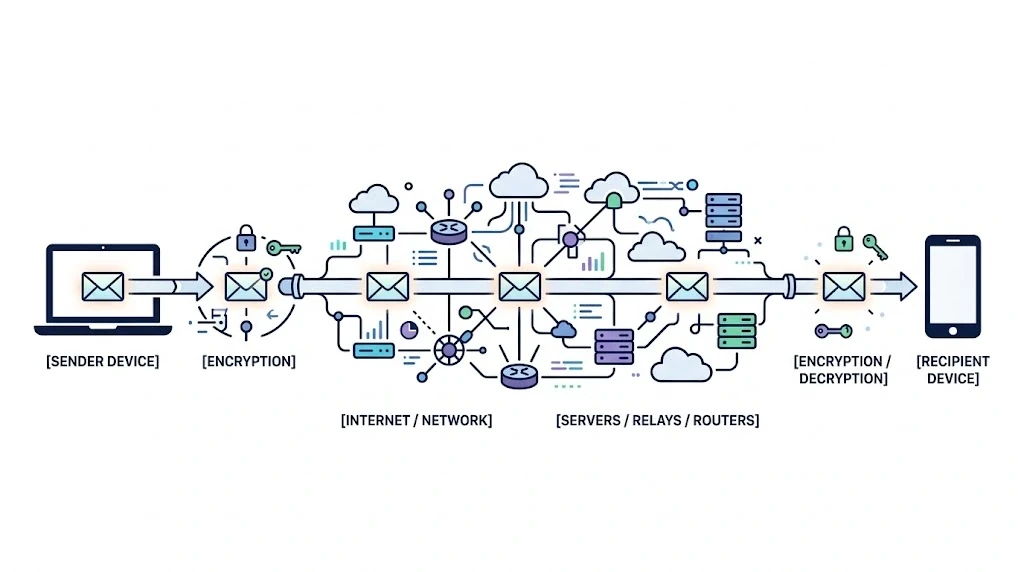
Under true end-to-end encryption, messages are encrypted on the sender's device and decrypted only on the recipient's authenticated hardware. The company hosting the servers holds zero cryptographic keys; it handles only opaque ciphertexts.
The mathematical rule: If a company cannot decrypt your messages, it is technically impossible for them to train an AI model on your conversation content.
Without end-to-end encryption, message contents sit in plaintext or under vendor-controlled encryption keys on corporate servers. In that architecture, your privacy relies entirely on corporate policy—a promise that can be rewritten at any time when business models shift or parent companies change hands.
The Tricky Part: AI Features Inside Encrypted Apps
Even inside apps that advertise end-to-end encryption, interactive AI features introduce subtleties that users must understand:
🤖 Direct Chatbot Interactions
When you direct-message a native AI assistant, that message must be decrypted by the AI's cloud infrastructure to compute a response. That conversation is rarely protected under pairwise E2EE.
📝 Thread Summarization
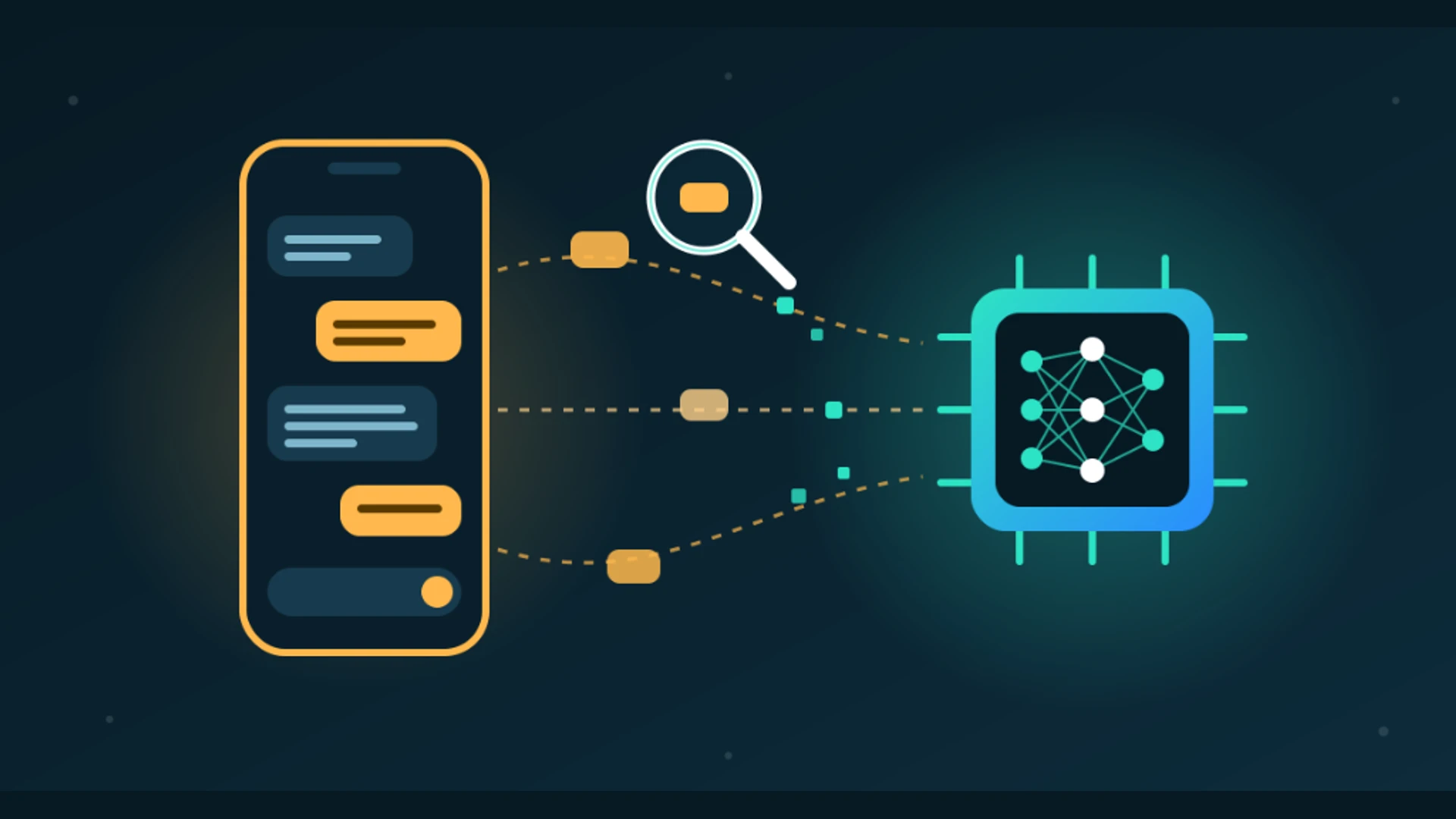
Clicking “Summarize Channel” may cause the client app to decrypt unread messages locally and forward the plaintext transcript to a cloud LLM provider for processing.
🔔 Group Mentions
Tagging an AI bot in an encrypted group frequently supplies the bot with surrounding conversational context so it can understand the thread history.
⚙ On-Device vs Cloud Inference
Some predictive text and smart-reply models operate entirely locally on your phone's neural engine. Others transmit keystrokes and context over the network.
The decisive architectural question is always: “Does this AI inference execute locally on my silicon, or is my plaintext streamed to remote servers?”
How to Check What Your Apps Are Doing
You do not need to be a cybersecurity auditor to verify your chat privacy. Follow these five checks:
- Search policy documents for key terms: Open the provider's privacy policy or terms of service and search for
AI,machine learning,train,model improvement, andcontent review. - Watch for ambiguous license grants: Phrases like “We use your content to improve and develop our services” frequently serve as legal umbrellas for AI training datasets.
- Audit your app settings: Check settings menus for “AI Features,” “Data Sharing,” or “Model Improvement” toggles. Opt out of non-essential data telemetry.
- Scrutinize terms-of-service updates: Major platform AI integrations are preceded by notification emails about updated terms. Read the summaries rather than dismissing them.
- Consider group consent: Before invoking an AI summarizer or bot in a multi-user channel, remember that you are submitting everyone's statements to that service, not just your own.
Simple Habits to Protect Your Conversations
Conversation Defense Rules
- ✓ Default to end-to-end encryption: Ensure personal conversations, sensitive company matters, and intimate discussions stay within cryptographically verifiable channels.
- ✓ Never feed secrets to AI assistants: Keep passwords, account credentials, social security numbers, and client records out of general-purpose AI prompts.
- ✓ Maintain clean boundaries: Use external AI productivity tools where beneficial, but keep your primary communication channels private and isolated.
- ✓ Regularly clear AI prompt history: Many conversational AI portals offer explicit settings to delete interaction logs and revoke training consent.
What We Believe at Lupyd
At Lupyd, our architectural philosophy is straightforward: your conversations belong solely to you and the people you intentionally communicate with.
Lupyd delivers a modern community experience—complete with servers, topic channels, voice spaces, and direct messages—engineered upon end-to-end encryption. Because our servers cannot decrypt your communications, we cannot read them, index them, or supply them to AI training pipelines. Privacy is not an optional policy switch; it is enforced by mathematics.
The Bottom Line
AI tooling inside communication apps is not inherently malicious, but users deserve absolute transparency regarding where their data travels. Whenever you evaluate a platform, demand answers to three core questions:
If an app cannot give you unambiguous answers, that opacity tells you everything you need to know about how your data is treated.
Want a community space where your conversations stay yours? Try Lupyd, encrypted by design.
Why Gen Z Is Starting to Care About Privacy • Which Messaging Apps Are End-to-End Encrypted? • Why Privacy Matters in Digital Communication
Last updated: 28 October 2026. This article covers privacy, machine learning practices, and conversational security. AI policies and provider terms evolve rapidly; verify specific features with platform documentation.
- ✓ Many chat apps introduce AI features for summarization and assistance, but data handling policies vary dramatically across platforms.
- ✓ Model training, real-time inference, and human review are separate stages—a service might not train on chats but still process them unencrypted.
- ✓ True end-to-end encryption makes server-side AI training mathematically impossible because servers never hold decryption keys.
- ✓ Using AI bots or cloud summarizers inside encrypted group chats can inadvertently expose unencrypted transcripts to third parties.
- ✓ Defaulting to zero-knowledge E2EE workspaces guarantees that your conversations remain private by mathematical design.
The workspace where nothing leaks
End-to-end encrypted channels and chat for your team, built on the Signal Protocol and MLS. Available on macOS, Windows, Linux and Android.