Two years ago, most websites asked for your age with a single drop-down menu and believed whatever you chose. That model is ending. Since July 2025 the UK has required "highly effective" age checks, Australia has barred under-16s from major social platforms, more than 25 US states have required age verification for adult sites, and the European Commission has proposed banning self-declared ages altogether.
This brief covers the laws in force and in progress as of late October 2026, how the largest platforms now check age, what the evidence says about whether it works, whether users can avoid it, and the trade-offs for privacy and free expression. Every figure links to a source at the end of the article. Where sources conflict or a claim rests on a single report, we say so or leave it out.
The Global Map at a Glance
| Jurisdiction | What it covers | Status | Maximum penalty |
|---|---|---|---|
| United Kingdom | Porn and content harmful to children; under-16 social media ban planned | In force since 25 Jul 2025; ban targeted for spring 2027 | £18m or 10% of global revenue |
| Australia | No accounts for under-16s on 10 social platforms; search engines age-check signed-in users | In force since 10 Dec 2025 | Up to A$49.5m (bill to double it) |
| European Union | DSA Art. 28 minor protection; proposed KIDS Act (no accounts under 13, supervised 13–14) | DSA in force; KIDS Act proposed 17 Sep 2026 | Up to 6% of global turnover |
| France | Double-blind checks for porn sites; under-15 ban struck down | Porn rules enforced since 2025 | Arcom blocking and fines |
| Italy | Double-anonymity checks for listed porn sites | Foreign sites from early 2026 | Up to €250,000 |
| United States | Porn-site AV in 25+ states; app-store laws in TX, UT, LA, AL, CA | Texas SB 2420 enforceable; CA AB 1043 from 1 Jan 2027 | Varies by state |
| Brazil | ECA Digital: no self-declaration, app-store age signals, parent-linked under-16 accounts | In force since 17 Mar 2026 | Up to 10% of Brazilian revenue, capped at R$50m |
| India | DPDP Rules: verifiable parental consent for under-18s | Applies from 14 May 2027 | Up to ₹200 crore |
| Indonesia | Under-16s barred from high-risk platforms | In force since 28 Mar 2026 | Penalty framework announced Sep 2026 |
| Singapore | App stores must block under-18s from 18+ apps | Required since 31 Mar 2026 | Up to S$1m |
Why This Matters Now
Three shifts happened between mid-2025 and late 2026:
From porn sites to the whole social web
Early laws targeted adult sites. The new wave covers Instagram, TikTok, YouTube, Snapchat, X, Reddit, Roblox, AI chatbots and app stores. Under a minimum-age law, every user has to be checked, not only those looking for adult content.
From websites to devices
Texas, Utah, Louisiana, Alabama, California, Brazil and Singapore now place duties on app stores or operating systems. Apple and Google have shipped APIs that pass an age band to apps.
From theory to enforcement
Ofcom has fined several sites and opened investigations into TikTok and Pornhub's owner. The European Commission has issued preliminary findings against Meta. Australia's eSafety Commissioner is preparing court action against five platforms.
Verification, Estimation, Assurance: The Terms
Regulators use three terms that are often confused:
- Age verification confirms age against an authoritative record, such as a passport, driving licence, bank or mobile operator.
- Age estimation infers a likely age, usually from a face scan or from account behaviour, and returns a probability rather than a fact.
- Age assurance is the umbrella term for both. The UK's standard is "highly effective age assurance". The EU's guidelines require methods that are accurate, reliable, robust, non-intrusive and non-discriminatory.
Self-declaration, where a user types a birthdate, does not count as age assurance in the UK, Brazil or under the proposed EU KIDS Act.
United Kingdom
The Online Safety Act 2023 made "highly effective age assurance" mandatory on 25 July 2025 for services that host pornography or other content Ofcom classes as harmful to children. Ofcom lists methods that can qualify: open banking, photo-ID matching, facial age estimation, mobile operator checks, credit card checks, digital identity services and email-based age estimation. Self-declaration, debit cards and terms-of-service clauses do not qualify. Fines can reach £18 million or 10% of qualifying worldwide revenue, whichever is greater, and Ofcom can ask courts to block non-compliant services.
Enforcement has so far focused on smaller adult sites and forums. Ofcom's June 2026 bulletin listed fines including £800,000 for Kick Online Entertainment (motherless.com), £600,000 for Youngtek Solutions, £540,000 for 4chan and £950,000 for a suicide forum. Two larger cases opened after that:
- TikTok (July 2026). Ofcom is examining whether TikTok's behavioural age inference is effective enough. TikTok says it complies.
- Aylo, owner of Pornhub (September 2026). Aylo blocked new UK visitors in February 2026, then in May restored access only for iPhone users whose adulthood Apple had confirmed at device level. Ofcom is investigating whether Aylo tested that signal adequately, saying some of its own tests let children through.
Ofcom's first statutory report on age assurance (July 2026) found that more than 69 million age checks were completed across 32 services in the second half of 2025. The share of children who faced a highly effective check when asked to verify rose from 25% to 43%. Ofcom also said it has "serious doubts" about some age inference models, and that no single method stops circumvention. It called for a layered approach covering apps, app stores, operating systems and devices.
The next step is larger. On 15 June 2026 the government confirmed an under-16 social media ban covering Snapchat, TikTok, YouTube, Instagram, Facebook and X, with WhatsApp, Signal and YouTube Kids excluded. The legal basis is a new section 214A of the Online Safety Act, inserted by the Children's Wellbeing and Schools Act 2026. A House of Commons Library briefing (October 2026) says the ban is expected from spring 2027, with regulations to be voted on by the end of 2026.
Australia
Australia's Social Media Minimum Age law took effect on 10 December 2025. Ten platforms must take "reasonable steps" to stop under-16s holding accounts: Facebook, Instagram, Threads, Snapchat, TikTok, YouTube, X, Reddit, Kick and Twitch. Messaging and gaming services such as Discord and Roblox are excluded. Children and parents face no penalty. Platforms face up to A$49.5 million per breach, and a 2026 bill to strengthen enforcement would double that ceiling and add compulsory evidence-gathering powers.
Platforms restricted about 4.7 million accounts in the first weeks. eSafety stressed that these are accounts, not unique children. Meta reported more than 750,000 removals by June 2026. eSafety's three-month evaluation, which surveyed 4,121 young people aged 10 to 16, found:
A real but partial drop.
Use with or without an account fell only slightly.
In March 2026 eSafety opened investigations into Facebook, Instagram, Snapchat, TikTok and YouTube. It cited children being allowed to retry age checks until they passed, and weak controls on new accounts. On 20 October 2026 the Communications Minister said eSafety is gathering evidence for Federal Court proceedings against all five. No penalty has yet been imposed under the law. Reddit and the Digital Freedom Project have challenged the law in the High Court.
Separately, an industry code required search engines to age-assure signed-in users by 27 June 2026 and apply the strictest safe search to likely minors. Signed-out users are not checked, but explicit images are blurred by default.
European Union and Member States
Article 28 of the Digital Services Act requires platforms accessible to minors to take "appropriate and proportionate" measures for their safety, but sets no minimum age. The Commission's July 2025 guidelines on protecting minors spell out what that means for age assurance. In April 2026 the Commission issued preliminary findings that Meta breaches the DSA by not keeping under-13s off Facebook and Instagram, where it estimates 10–12% of EU under-13s are active. A final decision could carry a fine of up to 6% of global turnover.
The Commission launched its age verification app in April 2026. It uses zero-knowledge proofs, so a user can prove they are over a threshold without revealing who they are. Security researchers reported flaws shortly after launch. A Commission recommendation asks member states to deploy it, either on its own or inside the EU Digital Identity Wallet, by 31 December 2026.
On 17 September 2026 the Commission proposed the EU KIDS Act. It is a proposal, not law, and commentators do not expect it to apply before about 2028. As drafted it would:
- bar social media accounts for children under 13, except guardian-managed children's video services;
- give 13 and 14-year-olds supervised accounts capped at one hour a day, with parents approving contacts;
- allow independent accounts from 15;
- ban self-declared ages and require EU-certified age verification;
- extend safety-by-design duties to games, AI chatbots and app stores, with fines of up to 6% of global turnover.
Member states are moving at different speeds:
France. Arcom's technical standard has required porn sites to offer at least one "double-blind" check since January 2025. Aylo withdrew Pornhub in protest in June 2025. In June 2026 the EU Court of Justice confirmed that France may impose these rules on sites based elsewhere in the EU through individual, proportionate measures. Parliament passed an under-15 social media ban in July 2026, but the Conseil constitutionnel struck it down on 14 August 2026 as a disproportionate restriction on free expression with insufficient privacy safeguards. The government is redrafting it.
Italy. AGCOM requires double-anonymity checks, repeated on every visit, for about 50 listed adult sites. Foreign sites had to comply by early 2026. Fines reach €250,000, and the first blocking orders came in March 2026.
Denmark. A draft under-15 law, with parental opt-in possible from 13, went to consultation in September 2026 and is expected to take effect on 1 July 2027.
Greece. Plans an under-15 ban from 1 January 2027, verified through the government's Kids Wallet app.
Germany. The cabinet adopted guidelines on 14 October 2026 for an interim under-13 ban, with verification through Germany's EUDI wallet from 2027. No bill has passed.
Spain and Norway. Spain announced an under-16 ban in February 2026; it has not yet passed. Norway plans an under-16 limit and expects to put a bill before parliament by the end of 2026.
United States
The legal turning point was Free Speech Coalition v. Paxton, decided on 27 June 2025. By 6 to 3, the Supreme Court upheld Texas's law requiring adult sites to verify age. It applied intermediate scrutiny rather than strict scrutiny, reasoning that the law only incidentally burdens adults' protected speech. Justice Kagan dissented, joined by Justices Sotomayor and Jackson. After the ruling, trackers count about 25 to 27 states with porn-site age verification laws. Aylo has responded by blocking Pornhub in many of them rather than verifying users.
The newer laws target app stores:
- Texas SB 2420 requires app stores to verify age and get parental consent for minors. A federal court blocked it in December 2025. The Fifth Circuit stayed that injunction in mid-2026, and the Supreme Court declined to intervene on 6 July 2026, so the law is now enforceable while the appeal continues.
- Utah, Louisiana and Alabama have similar laws. Their main duties now start in 2027.
- California AB 1043, operative from 1 January 2027, takes a lighter approach. The operating system asks for an age at device setup, without verifying it, and passes an age bracket (under 13, 13–15, 16–17, 18+) to apps. Apple, Google and Meta supported it.
State social media laws are more contested, because they require checking every user rather than visitors to adult sites. Florida's HB 3 (no accounts under 14) is enforceable after an appeals court lifted an injunction in November 2025. Mississippi's HB 1126 is in effect while litigation continues; Bluesky blocked the state in response. Laws in Georgia, Louisiana, Arkansas, Colorado and Virginia remain blocked, according to a June 2026 Loeb & Loeb survey.
At the federal level, the House passed the KIDS Act on 29 June 2026, and the Senate Commerce Committee advanced KOSA in August 2026. The two bills differ on a "duty of care" and on overriding state law, and neither has become law.
Brazil, India, Asia-Pacific, and Canada
Brazil. The ECA Digital (Law 15.211/2025) took effect on 17 March 2026. It applies to any service "likely to be accessed" by minors, including foreign ones. It bans self-declaration, requires app stores and operating systems to provide age signals, and requires under-16 social media accounts to be linked to a parent. Sanctions reach 10% of Brazilian revenue, capped at R$50 million per violation, plus possible suspension.
India. The DPDP Rules, notified on 14 November 2025, require verifiable parental consent before processing data of anyone under 18, from 14 May 2027. The parent's identity and age must be checked, for example through DigiLocker. Tracking, behavioural monitoring and targeted advertising aimed at children are prohibited. See our DPDP Act guide for the wider obligations.
Indonesia. Since 28 March 2026, under-16s may not use platforms classed as high-risk: YouTube, TikTok, Facebook, Instagram, Threads, X, Bigo Live and Roblox. Ages 16 and 17 need parental consent. TikTok deactivated about 780,000 accounts by April.
Malaysia. Has approved an under-16 ban using electronic identity checks with MyKad, passport or MyDigital ID. The regulator's Child Protection Code came into force on 1 June 2026. Privacy groups have objected to tying social media accounts to national ID.
China. Already requires real-name registration and a "minor mode" across devices, apps and app stores. Online games are limited to one hour a day on Fridays, weekends and holidays for minors. A new draft regulation on minors' internet use, including age verification, closed for comment on 17 October 2026.
Singapore. Since 31 March 2026, app stores (Apple, Google, Huawei, Samsung, Microsoft) must stop under-18s downloading 18+ apps, using Singpass, facial estimation, credit cards or account signals.
New Zealand and Canada. New Zealand introduced an under-16 bill in August 2026, with fines of up to 10% of global revenue; it excludes messaging and gaming and has not passed. Canada's Bill S-209, which would require age checks for commercial pornography, passed the Senate in April 2026 and is before the House of Commons.
How Platforms Check Age Today
Most large platforms now use a cascade. They first try to infer age from data they already hold. If that is inconclusive, or a user wants to unlock adult features, they ask for a face scan, and fall back to ID or a card. The face scan and ID check are usually run by a third-party vendor such as Yoti, Persona or k-ID.
| Platform | How it checks | Notes |
|---|---|---|
| Meta (Instagram, Facebook) | AI age inference from account signals; Yoti video selfie or ID when changing age to 18+; visual analysis to find under-13s (May 2026) | Teen Accounts private by default |
| YouTube | ML age estimation from watch and search history (US since Aug 2025); credit card, ID or selfie to appeal | Teens get no personalised ads |
| Discord | Face scan or ID via k-ID in UK and Australia; global teen-by-default from 2026 with on-device face estimation | Oct 2025 vendor breach exposed about 70,000 ID images |
| Selfie or ID via Persona for UK mature content | Reddit keeps status and birthdate; Persona keeps photos up to 7 days | |
| X | Existing signals first, then selfie estimation, ID, or phone-number check | Applies under UK, Irish, EU and Australian rules |
| Roblox | Facial estimation via Persona to use chat (global since 7 Jan 2026); ID for 13+ | Chat limited to adjacent age bands |
| Steam | Credit card on file for UK mature content | Debit cards not accepted |
| Spotify, Xbox | Yoti facial estimation, ID, card, or mobile carrier check (UK) | Unverified Xbox adults limited to friends-only social features |
| ChatGPT, Character.AI | Behavioural age prediction; Persona selfie to restore adult access | Character.AI ended open-ended chat for under-18s in Nov 2025 |
| Apple, Google Play | Declared Age Range API and Play Age Signals API pass an age band, not a birthdate; Apple asks UK adults to confirm 18+ by credit card or ID (iOS 26.4) | Texas accounts verified since mid-2026 |
Two patterns stand out. First, platforms increasingly default unverified users to the restricted experience. Discord's teen-by-default settings, ChatGPT's under-18 mode when age is uncertain, and Apple's UK content filters for unconfirmed users all put the burden on adults to prove their age. Second, the operating system is becoming the checkpoint. Apple's Declared Age Range API and Google's Play Age Signals API return an age band without a birthdate, ID or face scan. Aylo, Meta and the Free Speech Coalition have lobbied for this model. Age verification vendors oppose it, and Google has resisted being held liable for OS-level checks.
The Methods Compared
| Method | What you share | Accuracy | Privacy risk |
|---|---|---|---|
| ID document upload | Name, photo, date of birth, document number | High | Highest. Creates reusable identity stores; most breaches involve these |
| Facial age estimation | A selfie or short video, usually deleted after the check | About 1–2.5 years average error; worse for some groups | Medium. Lower if done on-device |
| Behavioural inference | Nothing new; uses existing activity data | Not disclosed; Ofcom has "serious doubts" | Medium. Normalises profiling and misclassifies adults |
| Credit card check | Card details with a payment processor | Medium. Cards can be borrowed | Low to medium. Excludes people without credit cards |
| OS or app-store signal | An age band, not identity | Depends on how the device owner was checked | Low for the user; liability unclear for services |
| Zero-knowledge proof or double-blind | A yes/no answer to "over 18?" | High if the credential issuer is reliable | Lowest. The site never sees identity; the issuer never sees the site |
On facial estimation accuracy: Yoti's own July 2025 white paper reports a mean absolute error of 1.1 years for 13 to 17-year-olds and 2.4 years across ages 6 to 70. NIST's independent evaluation (2024, updated through 2026) found that no algorithm performed best in every condition, and that error was consistently higher for female faces and varied by region of birth. Average error also hides the case that matters most: a 17-year-old estimated as 20 passes a check meant to stop them. Regulators therefore recommend a buffer, such as requiring an estimated age of 21 or 25 before skipping a second check.
On the double-blind model: France's CNIL designed it so the website learns only "over 18" and the verifier learns who you are but not which site asked. The EU app and Google's open-source longfellow-zk library apply the same idea with zero-knowledge proofs. Commentators note this is "double confidentiality" rather than true anonymity, because the credential issuer still knows your identity.
Does It Work? What the Data Shows
The honest answer is: partly, and less than headline numbers suggest.
Evidence it reduces exposure
- UK visits to adult sites fell by about a third after July 2025; Pornhub's UK audience dropped from 11.3m to 9.8m year on year (Ofcom).
- Children meeting a highly effective check rose from 25% to 43% (Ofcom).
- Australian under-16s with an account fell from 52.4% to 42.1% (eSafety).
- Platforms removed millions of underage accounts in Australia and Indonesia.
Evidence of displacement and evasion
- An NYU study found searches for the largest compliant adult site fell 51% after US state laws, while searches for a non-compliant rival rose 48% and VPN searches rose 24%.
- Ofcom found some non-compliant sites gained traffic as competitors added checks.
- 32% of UK children told Internet Matters they had bypassed an age check; 17% of parents said they had helped.
- Australian under-16 platform use, logged in or out, fell only from 85.9% to 81.5%.
The pattern across studies is consistent. Checks reliably reduce traffic to the compliant services that implement them. They are much less effective at reducing what a determined user, child or adult, can reach elsewhere.
Can You Avoid It?
This is the question most readers ask, so here is a direct answer for each situation.
On a compliant platform, mostly no
If a platform is legally required to check your age, it will restrict features until you comply. You can decline, but you will usually get the teen experience, lose access to some content, or be locked out. Appeals generally require more data, not less. Several platforms also re-check users whose behaviour suggests a different age.
VPNs: legal, common, and imperfect
VPN demand surged when checks began. Proton VPN reported UK sign-ups up more than 1,400% on 25 July 2025, and VPN apps briefly topped the UK App Store. Ofcom found that 25% of UK children aged 11 to 17 had used a VPN in the six months to March 2026, though only a small share said they used it to reach age-restricted content. In the UK, EU, US and Australia, using a VPN is legal for adults. The UK government told Parliament it is not considering a VPN ban. Ofcom has said platforms must not encourage VPN use to get around checks.
There are limits to keep in mind:
- A VPN changes location, not account history. Platforms that use account-level inference, such as YouTube, Meta or ChatGPT, and app-store laws tied to account region apply regardless of IP address.
- Free VPNs and non-compliant sites carry their own risks. Some free VPNs log and sell traffic, and sites that ignore age rules are more likely to ignore other safety and privacy rules.
- The legal position may change. Wisconsin lawmakers removed a VPN-blocking provision from a 2026 bill after public backlash, and a Michigan bill that would require ISPs to block VPNs has not advanced. Both show that lawmakers are watching VPN use.
Other workarounds are unreliable
In July 2025, PC Gamer confirmed that users could pass Discord's face check with a character from the video game Death Stranding. Children have also reported using borrowed IDs, fake birthdates and a parent's face. Tricks like these spread quickly but tend to be short-lived, and platforms such as Roblox now re-check accounts whose behaviour does not match their verified age.
What you can control: reduce what you hand over
For adults who have to verify, the realistic goal is to minimise the data that leaves your hands:
Use signals you already have. Many platforms clear older accounts automatically; X, for example, accepts accounts created in 2012 or earlier. Check whether you have already been cleared before uploading anything.
Prefer OS-level confirmation or a credit card over an ID upload. Apple's UK confirmation and Steam's card check do not require sending a document image to the service.
Prefer facial estimation, ideally on-device, over ID. An estimate returns only an age; an ID reveals your name, address and document number.
Avoid manual appeals and support tickets if you can. The Discord breach exposed IDs sent in age appeals to a support vendor, not those processed by the automated check.
Read the retention terms. Persona says it keeps Reddit verification photos for no more than 7 days, and Roblox says images are deleted immediately after processing. Where a service does not state a retention period, assume the data is kept.
Use zero-knowledge or double-blind options when offered. The EU app and France's double-blind providers are designed so the site never learns who you are.
Pros and Cons
The case for
- Children see harmful content early. England's Children's Commissioner found the average age of first exposure to pornography is 13; 27% had seen it by 11, and 59% first saw it by accident, mostly on social media.
- Self-declaration never worked. The Commission estimates 10–12% of EU under-13s use Facebook or Instagram despite a minimum age of 13.
- It reduces accidental exposure. Most measurable gains are at the major platforms where children actually spend time.
- It makes other protections enforceable. Teen defaults, contact limits and design rules only work if a platform knows who is a child.
- Privacy-preserving designs exist. Zero-knowledge and double-blind systems can confirm age without revealing identity.
The case against
- It creates breach targets. Discord (about 70,000 IDs), Tea (about 13,000 selfies and IDs) and PuffPal (about 1 million passports) all leaked data collected for age checks.
- It burdens adults' speech and anonymity. The EFF, ACLU and Open Rights Group argue that identity checks deter lawful access, especially for sensitive health, sexuality or political content.
- It excludes people. Adults without a passport, licence, credit card or smartphone can be locked out; Steam's UK check rejects debit cards.
- It is inaccurate at the margins. Estimation errors are larger for some demographics, and adults are routinely misclassified as teens.
- It displaces rather than removes risk. Users move to non-compliant sites and VPNs, which may be less safe.
- It fragments the internet. Bluesky blocked Mississippi and Aylo blocks entire states and countries rather than comply with incompatible rules (Internet Society).
The debate is not simply safety versus privacy. Many child-safety groups also question blanket bans. Ian Russell, whose daughter Molly's death led to the founding of the Molly Rose Foundation, called the UK's under-16 ban a "rush job"; the foundation argues that platform design duties matter more than blanket bans. Several privacy groups, in turn, accept age checks for adult sites but oppose checking every user of general-purpose platforms.
What Good Age Assurance Looks Like
If age checks are here to stay, the design choices determine how much harm they cause. Drawing on CNIL, ICO, Ofcom and Internet Society guidance, a defensible system should:
Return an attribute, not an identity. The service should learn "over 18" or an age band, never a name or birthdate.
Process on the device where possible. A face scan that never leaves the phone cannot leak from a server.
Separate the verifier from the service. Double-blind and zero-knowledge designs stop any single party from linking identity to browsing.
Delete by default, and prove it. Retention limits should be enforceable and audited, including for appeals and support vendors.
Offer a choice of methods. No single method works for everyone; people without ID or cards need an alternative.
Publish accuracy by demographic. Vendors and platforms should disclose error rates by age, sex and skin tone, tested independently.
What It Means for Private Messaging
Most of these laws treat private messaging differently from public social media. The UK's planned under-16 ban excludes WhatsApp and Signal, Australia's law excludes messaging services, and New Zealand's bill does the same. Lawmakers have generally accepted that one-to-one and small-group communication is not the same as algorithmic feeds open to strangers.
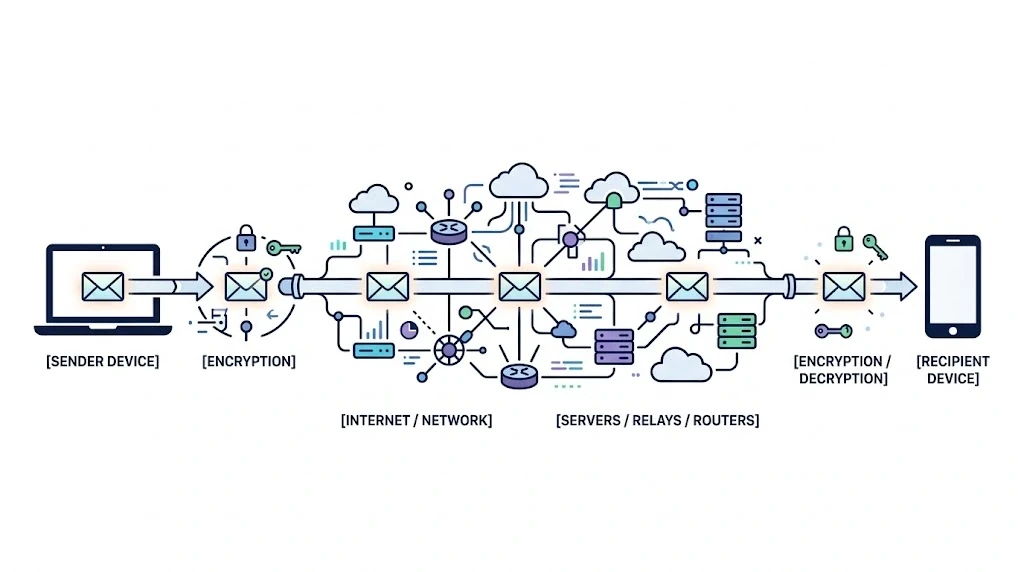
That distinction matters for how communication tools are built. At Lupyd, we build an end-to-end encrypted workspace where messages are encrypted with the Signal Protocol and MLS, keys stay on users' devices, and there are no ads or behavioural profiles. The lesson from the age verification debate applies to any service: the data you never collect cannot be breached, subpoenaed or misused. Where age checks are required, the privacy-preserving designs described above should be the default, not an option.
Frequently Asked Questions
Which countries require online age verification in 2026?
In force: the UK, Australia, France and Italy (adult sites), more than 25 US states (adult sites, plus Texas app stores), Brazil, Indonesia, Singapore (app stores) and Malaysia. Planned or proposed: EU-wide rules under the KIDS Act, a UK under-16 ban, and national laws in Denmark, Greece, Germany, Norway, Spain and New Zealand. India's parental consent rules apply from May 2027.
Is using a VPN to avoid age verification illegal?
Not in the UK, EU, US or Australia for adults. The laws place duties on platforms, not users. Ofcom says platforms must not encourage VPN use to bypass checks. A VPN does not get around account-level age inference or app-store rules.
What is the most private way to verify age?
Methods that never send a document to the service: on-device facial estimation, OS-level age signals, credit card checks, and zero-knowledge or double-blind credentials. ID uploads and manual appeals carry the most risk.
How accurate is facial age estimation?
Leading systems average one to two and a half years of error, depending on age. NIST found error was higher for female faces and varied by region of birth, so regulators recommend a buffer such as 21 or 25 before skipping a second check.
Did the US Supreme Court uphold age verification?
For adult sites, yes: Free Speech Coalition v. Paxton (June 2025) upheld Texas's law 6 to 3. Social media age verification is a separate question, and several state laws remain blocked.
The Bottom Line
Age verification has moved from a niche rule for adult sites to a default expectation across social media, app stores and AI services. The UK and Australia show that it changes behaviour on compliant platforms, and also that it pushes some users elsewhere and leaves many children online. The decisive question for the next two years is not whether checks happen, but how they are built: as identity collection that will eventually leak, or as privacy-preserving proofs that reveal only what is needed.
For users, the practical advice is to pick the least invasive method each platform offers. For builders, it is to treat every piece of identity data as a liability, and collect as little as the law allows.
Why Privacy Matters in Digital Communication • DPDP Act and Team Messaging Compliance • Vendor Risk: Is Your Provider Keeping Client Data Safe?
Sources & References:
- Ofcom: Report on the use of age assurance (2026)
- Lewis Silkin: Ofcom warns tougher action is needed on age assurance (Jul 2026)
- Ofcom: Online safety industry bulletin, June 2026
- Ofcom: Investigation into Aylo's age assurance compliance
- Biometric Update: Ofcom investigates TikTok age inference
- House of Commons Library: Under-16s social media ban briefing (CBP-10468)
- eSafety: SMMA three-month evaluation (Jul 2026)
- eSafety: Platforms restrict 4.7 million under-16 accounts
- ABC News: Five platforms under investigation (Mar 2026)
- ACS Information Age: Search engine age checking rules begin
- European Commission: EU age verification app
- European Commission: The KIDS Act explained
- SCL: Commission preliminarily finds Meta in breach of DSA
- CJEU: Press release on C-188/24 and C-190/24 (Jun 2026)
- Library of Congress: France's Constitutional Council rules against under-15 ban
- CNIL: Opinion on Arcom's age verification standard
- Biometric Update: Italy's AGCOM list of covered sites
- Plesner: Denmark's draft bill on social media age limits
- A News: Germany moves to ban social media for under-13s
- SCOTUSblog: Free Speech Coalition v. Paxton
- Digital Policy Alert: Supreme Court denies CCIA application on Texas SB 2420
- Future of Privacy Forum: Comparing enacted App Store Accountability Acts
- Kelley Drye: FAQ on California's Digital Age Assurance Act
- Loeb & Loeb: Children's online privacy 2026, state laws
- NetChoice: NetChoice v. Fitch (Mississippi)
- The Hill: House passes kids online safety package
- CNBC: KOSA advances in Senate Commerce
- PPC Land: Brazil's ANPD draft age verification guide
- SCC Online: DPDP Rules 2025 key highlights
- JURIST: Indonesia's social media restrictions for minors take effect
- NBC News: Malaysia plans under-16 social media ban
- Digital Policy Alert: China's draft regulation on minors' internet use
- Singapore Law Watch: App stores to screen under-18 users
- Euronews: New Zealand introduces under-16 legislation
- OpenParliament: Canada Bill S-209
- TechCrunch: Meta's AI visual analysis for underage users
- TechCrunch: YouTube rolls out age estimation in the US
- TechCrunch: Discord data breach affecting about 70,000 users
- MediaNama: Discord teen-by-default settings globally
- Social Media Today: Reddit implements UK age checks
- X Help Center: Age assurance
- TechCrunch: Roblox requires global age checks for chat
- TheSixthAxis: Steam UK credit card age checks
- The Register: Xbox and the Online Safety Act
- OpenAI: Our approach to age prediction
- Fortune: Character.AI ends open-ended chat for teens
- 9to5Mac: Ofcom welcomes Apple age verification in iOS 26.4
- Biometric Update: Pornhub returns to UK only for Apple-verified iOS users
- Yoti: Age estimation white paper (Jul 2025)
- NIST: Face analysis technology evaluation, age estimation
- Google: Open-sourcing zero-knowledge proofs for age assurance
- Tom's Guide: Proton VPN UK sign-up spike
- Mishcon de Reya: VPNs and age verification in the House of Lords
- PC Gamer: Death Stranding photo mode bypasses Discord check
- The Register: Internet Matters survey on bypassing age checks
- NYU CSMaP: Age verification and public adaptation
- EFF: Wisconsin VPN ban provision
- 404 Media: Michigan HB 4938
- The Record: Tea app breach
- Daring Fireball: PuffPal passport leak
- Children's Commissioner for England: Children and pornography (Aug 2025)
- Internet Society: Age restrictions and online safety policy brief
- EFF: Age verification is a privacy nightmare
- Open Rights Group: The great British firewall
- JURIST: Starmer sets spring 2027 target for under-16 ban
Last updated: 4 November 2026. This article is general information, not legal advice. Several laws described here are under legal challenge or still in draft, and platform policies change often; check primary sources before relying on any detail.
- ✓ Age checks are now law across much of the internet: the UK Online Safety Act (since July 2025), Australia's under-16 social media ban (since December 2025), more than 25 US state porn-site laws, Brazil's ECA Digital (March 2026) and Indonesia's under-16 rules (March 2026).
- ✓ The next wave moves responsibility to app stores and operating systems: Texas SB 2420 is in force, California AB 1043 starts in January 2027, and the proposed EU KIDS Act would ban self-declared ages outright.
- ✓ Platforms mostly use facial age estimation (Yoti, Persona, k-ID), ID uploads, credit cards, and behavioural age inference; Apple and Google now pass age-range signals to apps.
- ✓ The evidence on effectiveness is mixed: UK adult-site traffic fell by about a third and checked children rose from 25% to 43%, but in Australia platform use among under-16s fell only from 85.9% to 81.5%.
- ✓ Breaches are the largest cost: Discord (about 70,000 ID images), Tea (about 13,000 selfies and IDs) and PuffPal (about 1 million passports) all leaked data collected for age checks.
- ✓ Adults can rarely avoid checks on compliant platforms, but they can reduce exposure by choosing on-device estimation, credit card or OS-level signals over ID uploads, and by avoiding manual appeals that store documents.
The workspace where nothing leaks
End-to-end encrypted channels and chat for your team, built on the Signal Protocol and MLS. Available on macOS, Windows, Linux and Android.