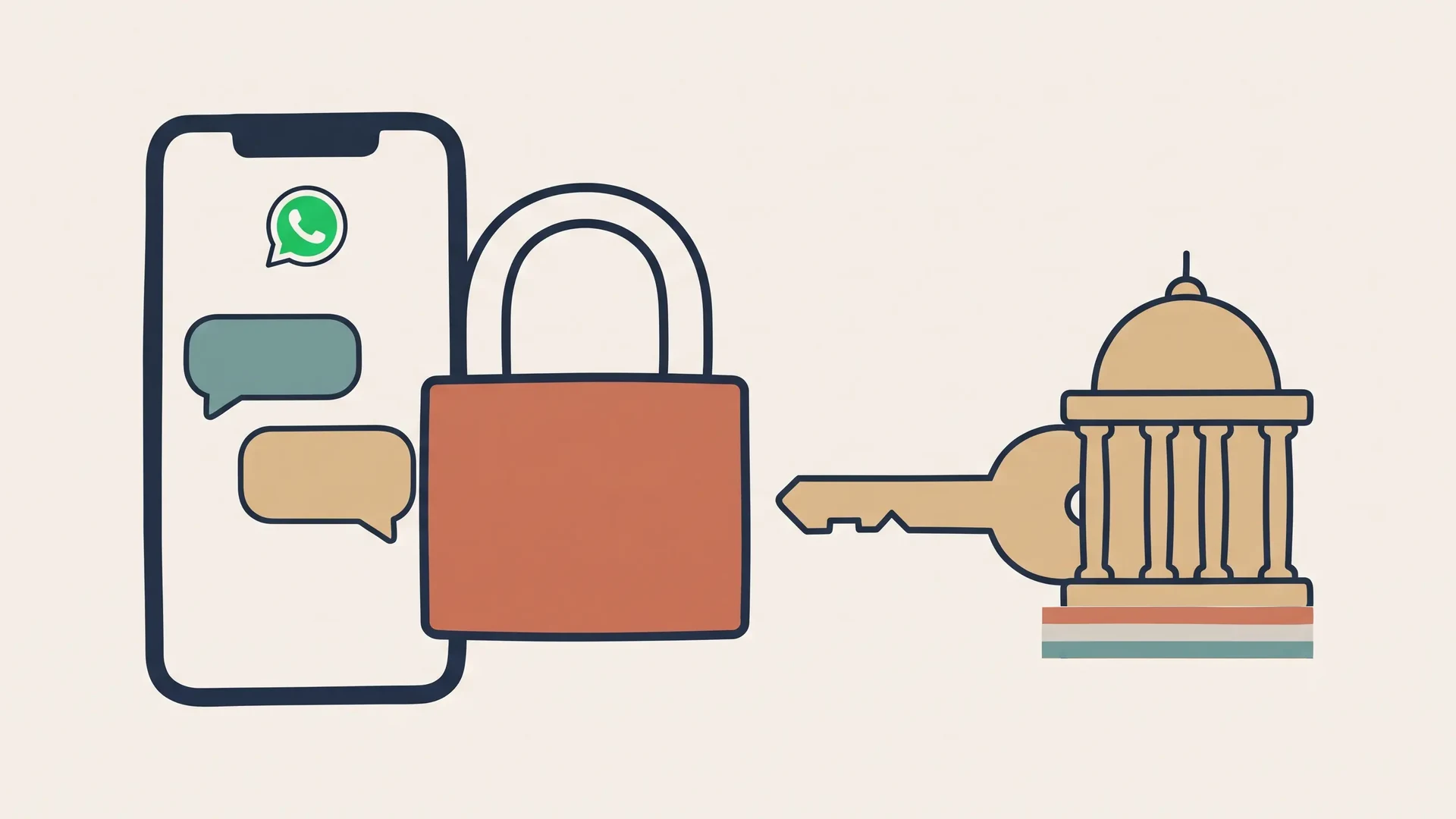
Short answer: no, not in 2026. As of 27 October 2026 there is no credible report of new talks between WhatsApp and the Indian government about breaking end-to-end encryption. The posts going viral this month, which say WhatsApp told the Delhi High Court it would leave India, describe a hearing from April 2024. The real 2026 story is quieter and more important: the government has stopped arguing about message content and started tightening control over identity, through phone numbers, SIM cards, usernames and the legal protection platforms rely on.
WhatsApp has more than 500 million users in India, by Meta's last official count, which makes it the country's default messaging app for families, businesses and government offices alike. What follows is what is verified, what is recycled, and what it means for anyone who depends on private messaging in India.
The Viral Claim, Checked
Around 23 October 2026, several sites published stories saying WhatsApp's lawyer, Tejas Karia, told a bench led by Acting Chief Justice Manmohan that WhatsApp would exit India if forced to break encryption. Those details date the hearing. Tejas Karia was sworn in as a Delhi High Court judge in February 2025, and in June 2026 he was the judge hearing the Telegram case. Justice Manmohan had already moved on from the Delhi High Court. A Oneindia fact-check, updated on 23 October 2026, rated the "Meta to exit India" claim misleading and traced it to a social media post based on the 2024 hearing.
The quote itself is real. On 25 April 2024 WhatsApp's counsel told the court: "As a platform, we are saying, if we are told to break encryption, then WhatsApp goes." He added: "There is no such rule anywhere else in the world. Not even in Brazil." It is WhatsApp's position, but it is not news.
The Traceability Case: Rule 4(2)
The underlying dispute is Rule 4(2) of the IT Rules 2021. It requires a significant social media intermediary that is "primarily in the nature of messaging", meaning one with more than 5 million Indian users, to identify the first originator of a message in India when ordered to. Only a court or an authority under Section 69 of the IT Act can issue the order, and only for offences such as threats to sovereignty, security of the State or public order, or crimes punishable by five or more years in prison, including rape and child sexual abuse material. The rule says platforms need not disclose message content, and orders should be used only when less intrusive means fail. The government said in 2021 that it did not intend "to break or weaken the encryption in any way."
WhatsApp's response, in its 2021 petition, was that tracing "is the equivalent of asking us to keep a fingerprint of every single message sent on WhatsApp, which would break end-to-end encryption." Its legal argument rests on the Supreme Court's 2017 Puttaswamy judgment, which recognised privacy as a fundamental right.
| Date | What happened |
|---|---|
| 25 Feb 2021 | IT Rules 2021 notified. Rule 4(2) requires large messaging apps to identify the "first originator" of a message on a court or government order. |
| 25–26 May 2021 | WhatsApp sues in the Delhi High Court, arguing traceability breaks end-to-end encryption and the right to privacy. |
| 27 Aug 2021 | The Delhi High Court issues notice to the Centre. |
| 22 Mar 2024 | The Supreme Court sends all pending High Court challenges to the IT Rules to the Delhi High Court to avoid conflicting judgments. |
| 25 Apr 2024 | WhatsApp's counsel tells the court: "if we are told to break encryption, then WhatsApp goes." |
| Oct–Nov 2024 | The court splits the batch: the code-of-ethics challenges first, then Part II, which contains Rule 4(2). Pleadings go to the Registrar. |
| 2025–Oct 2026 | No reported hearing or ruling on traceability. The case is pending. |
Five years after WhatsApp filed it, the case is undecided. That means Rule 4(2) remains on the books, the government has not been able to enforce it against WhatsApp, and WhatsApp has not been ordered to trace anyone.
What Actually Happened in 2026
While the traceability case stalled, the government used other tools. None of them requires WhatsApp to decrypt a message. Together they make it easier to tie every account to a real, verified person.
| Measure | Who | Status |
|---|---|---|
| Username freeze | MeitY | WhatsApp told not to launch in India (1 Jul 2026); reply under examination |
| SIM binding | DoT | Deadline 31 Dec 2026; enforcement from 1 Jan 2027 |
| Draft IT (Second Amendment) Rules | MeitY | Released for comment, Mar 2026 |
| Safe harbour review | Parliamentary panel, Centre | Under discussion; needs Parliament to change Section 79 |
| Telegram block | MeitY, upheld by Delhi HC | Blocked 16–22 Jun 2026 |
| Sanchar Saathi preinstall order | DoT | Withdrawn 3 Dec 2025 |
The username standoff: the only confirmed 2026 talks
WhatsApp announced @usernames on 29 June 2026. Two days later, on 1 July, MeitY told it not to roll the feature out in India "until consultations conclude to the satisfaction of the Government," warning that it "may materially increase the incidence of online fraud, phishing, digital arrest scams and impersonation attacks." The notice asked for a reply within three days and cited Section 79 of the IT Act and Rules 3 and 4 of the IT Rules, the same Rule 4 that contains the traceability duty. Similar notices went to Telegram and Signal, and Zoho's Arattai disabled its usernames.
A Meta team then met IT Ministry officials, the deadline was extended to 9 July, and Meta submitted a reply that MeitY said was "under examination." WhatsApp's argument was that every account still needs a mobile number, so it can still identify the number behind any username. As of October 2026 the feature remains on hold in India, and MeitY is reportedly drafting common standards for messaging platforms. An official quoted by the Hindustan Times said: "The rules have to be uniform for everyone."
The Internet Freedom Foundation said the notice "has no clear basis in law" and that Section 79 "is not a power for MeitY to decide what features the platform may offer." It urged MeitY to stop using "the contested traceability rule as leverage to control product design."
SIM binding: WhatsApp tied to your SIM card
On 28 November 2025 the Department of Telecommunications directed WhatsApp, Telegram, Signal, Snapchat, Arattai, ShareChat, Josh and JioChat to stay "continuously linked to the SIM card installed in the device," and to log out web sessions periodically, requiring a fresh QR-code login. DoT cited more than ₹22,800 crore lost to cyber fraud. Its legal basis is an October 2025 amendment to the Telecom Cyber Security Rules, which created a new category of "Telecommunication Identifier User Entities" to bring apps that use phone numbers under DoT's reach. Reports at the time said web sessions would end every six hours, but in April 2026 the Minister of State told the Rajya Sabha that "no specific time period has been stipulated." Meta confirmed it was testing SIM binding with Indian users in April. The compliance deadline has been extended to 31 December 2026, with enforcement from 1 January 2027. Reports conflict on whether Signal and Snapchat remain covered.
Safe harbour under pressure
Section 79 of the IT Act protects platforms from liability for what users post, as long as they follow government rules. In August 2026 the parliamentary Standing Committee on Communications and IT questioned Meta after a video of Prime Minister Modi was briefly unavailable on Facebook. Its chair, Nishikant Dubey, said Mark Zuckerberg should apologise "or safe harbour protection should be withdrawn." Separately, the Centre told a Supreme Court-monitored committee on "digital arrest" fraud that it is reviewing safe harbour. In that proceeding WhatsApp argued that labelling rules for AI-generated content cannot apply to end-to-end encrypted messages, because "not even WhatsApp" can see them. Only Parliament can change Section 79, but losing safe harbour is the most serious lever the government holds over any platform.
New draft rules, a Telegram block, and a reversed order
- Draft IT (Second Amendment) Rules 2026. Released in March 2026, the draft requires platforms to follow ministry orders that state a legal basis and to retain registration and usage data for periods set by law. A separate amendment notified in February 2026 extends the meaning of "information" in Rule 4(2) to AI-generated content.
- Telegram block. MeitY blocked Telegram nationwide from 16 to 22 June 2026 ahead of the NEET-UG re-exam, citing identity concealment through usernames and mirror bots. The Delhi High Court upheld the block as proportionate. It is the clearest precedent that India will block an entire messaging app.
- Sanchar Saathi. DoT ordered phone makers in late 2025 to preinstall its Sanchar Saathi app, then withdrew the order on 3 December 2025 after a privacy backlash. Communications Minister Jyotiraditya Scindia said "snooping is neither possible nor will it happen."
- Privacy in the Supreme Court. In a separate case over WhatsApp's 2021 privacy policy, which concerns data sharing with Meta rather than encryption, the Supreme Court said in February 2026 that WhatsApp "cannot play with the right to privacy." WhatsApp told the court it would comply with the competition regulator's directions.
Why Traceability and End-to-End Encryption Don't Fit
End-to-end encryption means only the sender's and recipients' devices hold the keys. WhatsApp's servers relay ciphertext they cannot read. Traceability asks a different question: not "what does this message say" but "who first sent it." The problem is that nobody knows in advance which message will be the subject of an order. To answer the question for one message later, a platform would have to record an identifier for every message now, including every forward, and keep it for years.
The government's 2021 idea, as reported, was a hash that travels with each message. Critics identified three problems:
- It is easy to evade. Changing a single character, or re-saving an image, produces a new hash and a new "first originator."
- It is easy to frame someone. Anyone who receives content from outside WhatsApp and is the first to share it becomes its originator, even if they did not create it.
- It creates a permanent record outside the encryption. The content of messages stays encrypted, but a lasting link between people and the things they shared undermines the deniability and minimal metadata that protocols like Signal's are designed to provide.
In 2019, IIT Madras professor V. Kamakoti proposed attaching originator information to messages, either visibly or encrypted with a key held in escrow, and argued that "their end-to-end encryption remains the same." Researchers including Manoj Prabhakaran of IIT Bombay argued the scheme was open to falsification. A 2022 study by IAMAI and The Dialogue, covering 70 stakeholders, found intermediaries and cybersecurity experts unanimous that traceability is not possible without breaking encryption. A minority of cryptographers have argued that some forms of secure traceability may be feasible, but no such scheme has been deployed at WhatsApp's scale.
Section 69 of the IT Act and the 2009 Interception Rules already allow authorised agencies to intercept or decrypt information. For end-to-end encrypted messages, that in practice means access to a device, by seizing it or by compromising it with spyware. That is why the Pegasus case, in which WhatsApp won a permanent injunction against NSO Group in a US court in October 2025, remains part of this debate.
How Other Countries Have Handled It
- United Kingdom. In early 2025 a secret order under the Investigatory Powers Act sought access to Apple's encrypted iCloud backups, and Apple withdrew Advanced Data Protection for UK users instead of building a backdoor. Legal challenges are before the Investigatory Powers Tribunal.
- European Union. The proposed Child Sexual Abuse Regulation, known as Chat Control, has been in negotiation through 2026. The Council's position reportedly dropped mandatory scanning of encrypted messages. No final deal has been confirmed.
- Australia. The 2018 Assistance and Access Act lets agencies require technical help from companies but explicitly bars any requirement to build a "systemic weakness or systemic vulnerability."
- European Court of Human Rights. In Podchasov v. Russia (2024), the court held that ordering Telegram to provide decryption keys violated the right to privacy.
- Signal. President Meredith Whittaker has said repeatedly that Signal would leave a market rather than weaken its encryption.
What It Means for Users and Businesses
For now, your WhatsApp messages in India remain end-to-end encrypted, and no court or regulator has ordered otherwise. What is changing is the layer around the messages:
- Your account is becoming more firmly tied to your identity. SIM binding links WhatsApp to a SIM issued against government ID, and the username freeze keeps the phone number as the identifier.
- Desktop and web use will change. Periodic logouts under SIM binding will affect anyone who runs WhatsApp Web on an office computer, including teams that use it for client work.
- Platform features can now be stopped before launch. The username notice shows MeitY is willing to block a product change, not only content.
- Metadata matters as much as content. Encryption protects what you say. It does not hide who you talk to, when, or from which number. For confidential work, the amount of metadata a platform keeps is part of the risk.
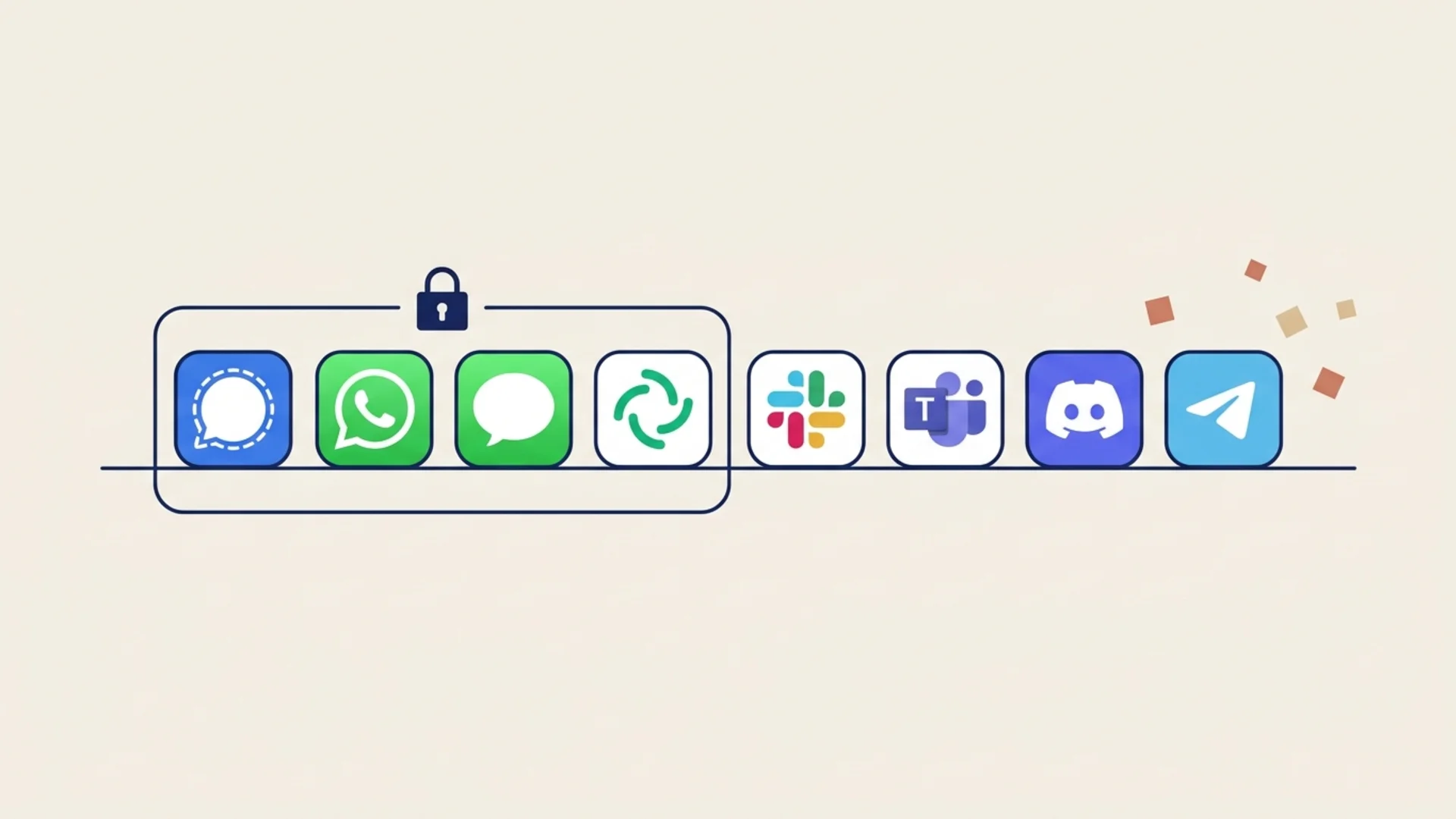
For businesses, the practical lesson is not to rely on a single consumer app for confidential work, and to understand what each tool can see. Our guides on which messaging apps are end-to-end encrypted and the DPDP Act for team messaging cover the wider picture. Lupyd end-to-end encrypts direct messages (Signal Protocol), group channels (MLS, RFC 9420) and files by default, built for teams that need private workspaces. Try Lupyd alongside the tools you already use.
Frequently Asked Questions
Is WhatsApp leaving India in 2026?
There is no credible report that it is. The viral October 2026 posts quote WhatsApp's lawyer telling the Delhi High Court in April 2024 that "if we are told to break encryption, then WhatsApp goes." A Oneindia fact-check rated the 2026 "exit India" claim misleading.
Has the Indian government forced WhatsApp to break encryption?
No. Rule 4(2) of the IT Rules 2021 requires large messaging apps to identify the first originator of a message when ordered, and WhatsApp says that cannot be done without breaking end-to-end encryption. WhatsApp challenged the rule in the Delhi High Court in May 2021, and the case has not been decided.
What is WhatsApp SIM binding in India?
A Department of Telecommunications directive requires messaging apps such as WhatsApp, Telegram and Arattai to stay linked to the active SIM card in the device and to log out web sessions periodically. The compliance deadline was extended to 31 December 2026, with enforcement from 1 January 2027.
Why did MeitY stop WhatsApp usernames in India?
On 1 July 2026 MeitY told WhatsApp not to launch usernames in India until consultations concluded, saying the feature could increase fraud, phishing, digital arrest scams and impersonation. Meta met IT Ministry officials and replied, and MeitY said the response was under examination.
Can the Indian government read WhatsApp messages?
Not by asking WhatsApp, because messages are end-to-end encrypted and WhatsApp does not hold the keys. Section 69 of the IT Act lets authorised agencies intercept or decrypt information, but for end-to-end encrypted content that requires access to a device, for example through seizure or spyware.
Final Takeaway
The headline fight, whether India can force WhatsApp to break end-to-end encryption, is unresolved and has been quiet in court since 2024. The 2026 fight is about everything around the encryption: which number an account is tied to, which features may launch, and whether a platform keeps its legal shield. Watch three dates: the SIM-binding deadline on 31 December 2026, any final word on usernames and MeitY's messaging standards, and the next listing of WhatsApp's traceability challenge in the Delhi High Court.
Sources & References:
- Oneindia: Fact-check on WhatsApp and Instagram shutting down in India (Oct 2026)
- Bar & Bench: Tejas Karia takes oath as Delhi High Court judge
- India TV: WhatsApp tells Delhi High Court it will exit India if forced to break encryption (Apr 2024)
- The News Minute: WhatsApp challenges IT Rule (May 2021)
- LiveLaw: Delhi High Court issues notice on WhatsApp's traceability plea
- LawBeat: Centre's release on tracing the first originator
- MediaNama: Supreme Court transfers IT Rules petitions to Delhi High Court
- Internet Freedom Foundation: IT Rules 2021 hearing update (Nov 2024)
- MediaNama: MeitY notice to WhatsApp on usernames (Jul 2026)
- MediaNama: MeitY notices to WhatsApp, Signal and Telegram
- The Tribune (ANI): Meta submits reply on WhatsApp usernames
- MediaNama: MeitY drafting messaging standards after username dispute
- MediaNama: Phone numbers, scrutiny and WhatsApp usernames (Oct 2026)
- Internet Freedom Foundation: On MeitY's username notices
- News on AIR: DoT mandates SIM binding for messaging apps
- India Briefing: Telecom Cyber Security Rules 2025 and messaging apps
- MediaNama: WhatsApp tests SIM binding; Rajya Sabha reply on logout period
- MediaNama: SIM binding deadline extended to December 2026
- Adgully: SIM binding by 31 December (Oct 2026)
- ANI: Parliamentary panel chief on safe harbour (Aug 2026)
- ThePrint: Government examining review of safe harbour
- PolicyEdge: Draft IT Rules 2026
- Bar & Bench: Delhi High Court upholds temporary Telegram ban
- Gulf News: India withdraws Sanchar Saathi preinstall order
- The Wire: Supreme Court on WhatsApp's privacy policy (Feb 2026)
- Business Today: Section 69 and authorised decryption
- Inc42: Government's proposed traceability system
- MediaNama: Interview with Prof. V. Kamakoti on traceability (2019)
- LiveLaw: IFF opposes IIT professor's traceability proposal
- Inc42: IAMAI and The Dialogue study on traceability
- Internet Society: Traceability and cybersecurity
- CyberScoop: WhatsApp wins injunction against NSO Group
- CyberInsider: UK pressures Apple again for a backdoor
- Patrick Breyer: Chat Control tracker
- Herbert Smith Freehills: Australia's Assistance and Access Act
- LiveLaw: Podchasov v. Russia and WhatsApp in India
- TechRadar: Signal would rather leave than weaken encryption
- TechCrunch: WhatsApp's user base in India
Last updated: 27 October 2026. This article is general information, not legal advice. Several measures described here are in draft, under review or before the courts; check primary sources before relying on any detail.
- ✓ The October 2026 posts saying WhatsApp threatened to leave India describe an April 2024 Delhi High Court hearing; there is no credible report of new 2026 talks on breaking encryption.
- ✓ WhatsApp's challenge to the IT Rules 2021 traceability requirement, Rule 4(2), was filed in May 2021 and is still undecided; the last reported hearing was in 2024.
- ✓ The only confirmed 2026 meeting between Meta and MeitY was about WhatsApp usernames, which MeitY told WhatsApp not to launch in India in July 2026, citing fraud and impersonation.
- ✓ DoT's SIM-binding rules require WhatsApp and other messaging apps to stay tied to an active SIM, with enforcement from 1 January 2027.
- ✓ The government's pressure has shifted from message content to identity: phone numbers, SIMs, usernames and safe harbour, all of which work around encryption rather than through it.
- ✓ Tracing the first originator of one message means tagging every message, which is why WhatsApp, security researchers and digital rights groups say it cannot coexist with end-to-end encryption.
The workspace where nothing leaks
End-to-end encrypted channels and chat for your team, built on the Signal Protocol and MLS. Available on macOS, Windows, Linux and Android.