If you follow web networking standards, WebTransport looks like a solved problem. Chromium-based browsers have supported it since version 97, Firefox shipped it in version 114, and Safari enabled it by default in Safari 17.4. All major browser engines can open QUIC connections, spawn multiplexed bidirectional streams without head-of-line blocking, and transmit unreliable datagrams directly from JavaScript.
Yet open the network inspector on almost any live web product today (collaborative canvases, trading terminals, multiplayer engines, or our own messaging apps) and WebTransport is nowhere to be found. Everyone is still running WebSockets over TCP or HTTP/2.
Why? Because the bottleneck in 2026 is no longer the browser. It is the reverse proxy and edge routing layer. The vast majority of reverse proxies (Nginx, HAProxy, Traefik, and commercial CDN reverse proxies like Cloudflare) support HTTP/3 for standard website traffic, but flatly fail when asked to reverse-proxy WebTransport sessions to backend origins.
In this article, we examine why WebTransport is fundamentally not a "WebSocket upgrade," analyze the architectural reasons why reverse-proxying WebTransport is an order of magnitude more difficult than proxying WebSockets, show visually how WebTransport enables revolutionary single-connection edge-to-origin aggregation, review the exact state of proxy support across the industry, and share our experience implementing WebTransport behind a feature flag inside Lupyd's open-source messaging engine, Firefly.
The Production Paradox: Ready in Browsers, Blocked Everywhere Else
For over a decade, developers building interactive web applications faced an intractable networking constraint: browser transports were fundamentally rigid.
If you needed bidirectional, server-initiated messaging, you used WebSockets governed by RFC 6455. But WebSockets force all messages into a single, ordered TCP byte stream. If a single packet is dropped on a congested cellular tower or spotty Wi-Fi link, the operating system kernel holds back all subsequent data until the lost segment is retransmitted. This is TCP head-of-line (HoL) blocking: a 30-byte user presence ping or an urgent cryptographic key acknowledgment gets stalled behind a 500KB image upload simply because they share the same TCP socket.
WebRTC Data Channels offered UDP-like unreliability and unordered delivery, but at a punishing operational cost: full ICE, STUN, and TURN negotiation, mandatory DTLS handshakes, and complex signaling servers just to exchange bytes with a cloud service.
WebTransport was designed by the W3C and IETF to be the modern transport foundation the web had always lacked:
Chrome / Edge
Shipped WebTransport over HTTP/3 in Chrome 97 (January 2022). Production ready for over 4 years.
Mozilla Firefox
Supported natively since Firefox 114 (June 2023) across Windows, macOS, and Linux desktop builds.
Apple Safari / WebKit
Enabled WebTransport over HTTP/3 by default in Safari 17.4 (March 2024) across iOS, iPadOS, and macOS.
According to Can I Use, browser support covers over 95% of active global users. The W3C WebTransport Editor's Draft and MDN WebTransport API documentation are fully standardized. Why haven't production applications swapped out their WebSocket libraries? The answer lies in the server-side architectural plumbing between the browser and the application backend.
Myth Busting: WebTransport Is NOT a WebSocket Upgrade
One of the most persistent misconceptions in frontend engineering is the assumption that WebTransport is simply "WebSocket 2.0" or "WebSockets over QUIC."
Common Myth: "WebTransport is an HTTP upgrade header for WebSockets over QUIC"
The Reality: WebTransport is not an HTTP upgrade, nor is it a WebSocket flavor. WebSockets over HTTP/3 actually exists as an entirely separate IETF standard (RFC 9220: Bootstrapping WebSockets with HTTP/3), just as WebSockets over HTTP/2 exists in RFC 8441. WebTransport is an independent, protocol-agnostic transport layer framework (draft-ietf-webtrans-overview) designed to operate across multiple underlying substrates.
WebSockets (RFC 6455) defines an application-layer framing format pinned to a single reliable stream:
- It provides
TEXTandBINARYframes,PING/PONGheartbeats, and aCLOSEhandshake. - It assumes that the underlying layer is an unbroken, strictly ordered FIFO stream.
- If you want multiple logical channels over a WebSocket, your application must invent its own framing, multiplexing headers, channel IDs, and flow control.
In contrast, WebTransport does not provide message framing or typed envelopes. Instead, WebTransport provides transport primitives: the ability to open arbitrary raw byte streams and send datagrams directly through browser JavaScript.
Crucially, WebTransport is specified as an abstract transport interface that can run on top of several protocols:
- WebTransport over HTTP/3 (draft-ietf-webtrans-http3): The primary browser implementation. Runs on UDP via RFC 9000 (QUIC) and RFC 9114 (HTTP/3), leveraging HTTP/3's Extended CONNECT method and HTTP Datagrams (RFC 9297).
- WebTransport over HTTP/2 (draft-ietf-webtrans-http2): An official IETF fallback specification for enterprise firewalls that block UDP port 443. It maps streams to HTTP/2 streams and encapsulates datagrams inside capsule frames over TCP.
- Direct WebTransport over raw QUIC (draft-ietf-webtrans-quic): Allows embedding WebTransport semantics into non-web environments without the HTTP request/response state machine.
- WebTransport over WebSockets / WebRTC: The abstract API can even be mapped over existing duplex pipes when running in legacy environments.
Transport Primitives: Streams, Multiplexing, and Datagrams
To understand why WebTransport is fundamentally different from WebSockets, look at the W3C WebTransport API in action:
// 1. Establish WebTransport session over HTTP/3 (QUIC)
const transport = new WebTransport("https://gateway.lupyd.com:4433/wt/v1");

// Await the handshake (extended CONNECT with :protocol = webtransport)
await transport.ready;
console.log("WebTransport session established over QUIC connection!");

// 2. Open an independent bidirectional stream for a tiny RPC
async function sendRpc(method: string, payload: Uint8Array): Promise<Uint8Array> {
  const stream = await transport.createBidirectionalStream();
  const writer = stream.writable.getWriter();

  // Write request bytes (isolated stream, zero head-of-line blocking)
  await writer.write(payload);
  await writer.close();

  // Read response bytes asynchronously
  const reader = stream.readable.getReader();
  const chunks: Uint8Array[] = [];
  while (true) {
    const { value, done } = await reader.read();
    if (done) break;
    chunks.push(value);
  }
  return concatBytes(chunks);
}

// 3. Send an unreliable, out-of-order Datagram for real-time presence/typing
const datagramWriter = transport.datagrams.writable.getWriter();
await datagramWriter.write(new TextEncoder().encode("user_42:typing:active"));
Instead of a single socket.send(data) pipe, WebTransport equips the application with three distinct communication primitives:
1. Unidirectional Streams
A lightweight, ordered, reliable byte stream that only travels in one direction. One endpoint writes; the other reads. Ideal for chunked file uploads, logging telemetry, or pushing server broadcast events without allocating memory for an unused return channel.
2. Bidirectional Streams
Two paired reliable byte streams (incoming and outgoing) representing an independent request/response lifecycle. Each stream carries its own flow-control budget. If Stream A loses packets, Stream B proceeds without delay.
3. HTTP Datagrams (Unreliable)
Unreliable, out-of-order, packet-sized payloads (RFC 9297). If a packet drops, it is gone forever without retransmission. Unlike raw UDP, HTTP Datagrams stay strictly governed by QUIC congestion control to prevent link saturation.
WebTransport streams also support independent cancellation. Either peer can call stream.writable.abort(errorCode) or stream.readable.cancel() at any moment. The underlying transport sends a QUIC RESET_STREAM or STOP_SENDING frame, immediately freeing buffer memory on both sides without terminating the overall connection. In WebSockets, aborting an in-flight 5MB message requires either closing the entire TCP connection or burning bandwidth reading and discarding useless bytes.
Protocol Wire Comparison: WebSocket vs. WebTransport
The architectural divergence between the two protocols is visible at every layer of the networking stack:
| Capability | WebSocket (RFC 6455) | WebSocket over H2/H3 (RFC 8441/9220) | WebTransport over HTTP/3 |
|---|---|---|---|
| Underlying Transport | TCP + TLS (RFC 8446) | TCP (H2) or QUIC/UDP (H3) | QUIC / UDP (RFC 9000) |
| Channel Architecture | Single serial channel | Single stream inside H2/H3 | Multiplexed: Unlimited streams + datagrams |
| Head-of-Line Blocking | Yes (TCP packet loss stalls everything) | Yes on H2 (TCP HoL); No on H3 (per connection) | Zero across streams (stream isolation) |
| Unreliable Delivery | Impossible (TCP guarantees delivery) | Impossible (Streams are reliable) | Native via RFC 9297 HTTP Datagrams |
| Cold Handshake Latency | 3 RTT (TCP SYN + TLS 1.3 + HTTP 101) | 3 RTT on H2 / 1-2 RTT on H3 | 1 RTT (QUIC + TLS 1.3 + CONNECT) or 0-RTT |
| Connection Migration | Fails on IP change (Wi-Fi ↔ LTE drops socket) | Fails on H2; Works on H3 | Native (QUIC Connection IDs preserve session) |
| Flow Control | Global TCP receive window only | Stream + Connection-level flow control | Per-stream window + Connection window |
| Reverse Proxy Model | Simple blind TCP pipe (byte copier) | H2/H3 stream forwarding | Extremely complex (Multi-stream demuxing) |
Look closely at that last row. That single row explains why WebTransport is stalled across the internet.
The Proxy Problem: Why Reverse Proxies Are Stuck
To understand why modern reverse proxies struggle with WebTransport, compare how a proxy handles a WebSocket connection versus how it must handle WebTransport.
How Reverse Proxies Handle WebSockets (The Blind Pipe)
When a browser opens a standard WebSocket connection through Nginx or HAProxy:
- The client sends an HTTP/1.1 request:
Upgrade: websocket,Connection: Upgrade. - The proxy evaluates its routing rules (e.g.,
location /ws) and passes the HTTP request to an upstream backend. - The backend returns
HTTP/1.1 101 Switching Protocols. - The proxy sends the
101back to the client. - From that exact millisecond onward, the proxy ceases to act as an HTTP server. It switches the downstream socket and upstream socket into a raw, bidirectional byte-pumping loop (often using the
splice()syscall in Linux). The proxy does not parse WebSocket frames, does not inspect payloads, and does not need to understand what is happening inside the TCP pipe.
The WebSocket Proxy Invariant: 1 downstream TCP connection = 1 upstream TCP connection. The proxy is a dumb, protocol-agnostic byte conduit.
How WebTransport Actually Works: The Multi-Stream Dilemma
WebTransport over HTTP/3 does not work like a WebSocket byte pipe.
First, WebTransport does not use an HTTP Upgrade header. It initiates with the HTTP/3 Extended CONNECT method (RFC 9220 / draft-ietf-webtrans-http3):
When the server responds with a 200 OK on that HTTP/3 stream, that stream becomes the WebTransport Session.
Here is the critical design decision that breaks traditional reverse proxies: application data does NOT flow over the CONNECT stream!
Instead, WebTransport asks the underlying protocol (QUIC / HTTP/3) to spawn more streams and forward datagrams!
- When JavaScript calls
transport.createBidirectionalStream(), WebTransport does not slice up bytes and frame them inside the CONNECT stream. - Instead, WebTransport commands the underlying QUIC transport: "Allocate a brand-new QUIC stream on this existing QUIC connection."
- The underlying protocol creates a new QUIC stream (e.g. Stream 16). To indicate that this stream belongs to the WebTransport session, HTTP/3 prefixes the stream with a variable-length integer (varint) representing the Session ID (which matches the Stream ID of the original CONNECT request).
- When JavaScript writes to
transport.datagrams.writable, the packet is encapsulated as an HTTP Datagram (RFC 9297) inside a QUICDATAGRAMframe, prefixed with the quarter-stream ID of the session.
The Architectural Consequence: Streams and datagrams do not originate from the WebTransport session stream. They are dynamically spawned child streams on the parent QUIC connection, linked only by a numerical Session ID header!
The Shared Connection Hazard: Why Blind Tunnels Don't Work
At this point, a systems engineer might ask: "Why can't the reverse proxy just blindly forward the entire QUIC connection to the backend, exactly like it did with TCP?"
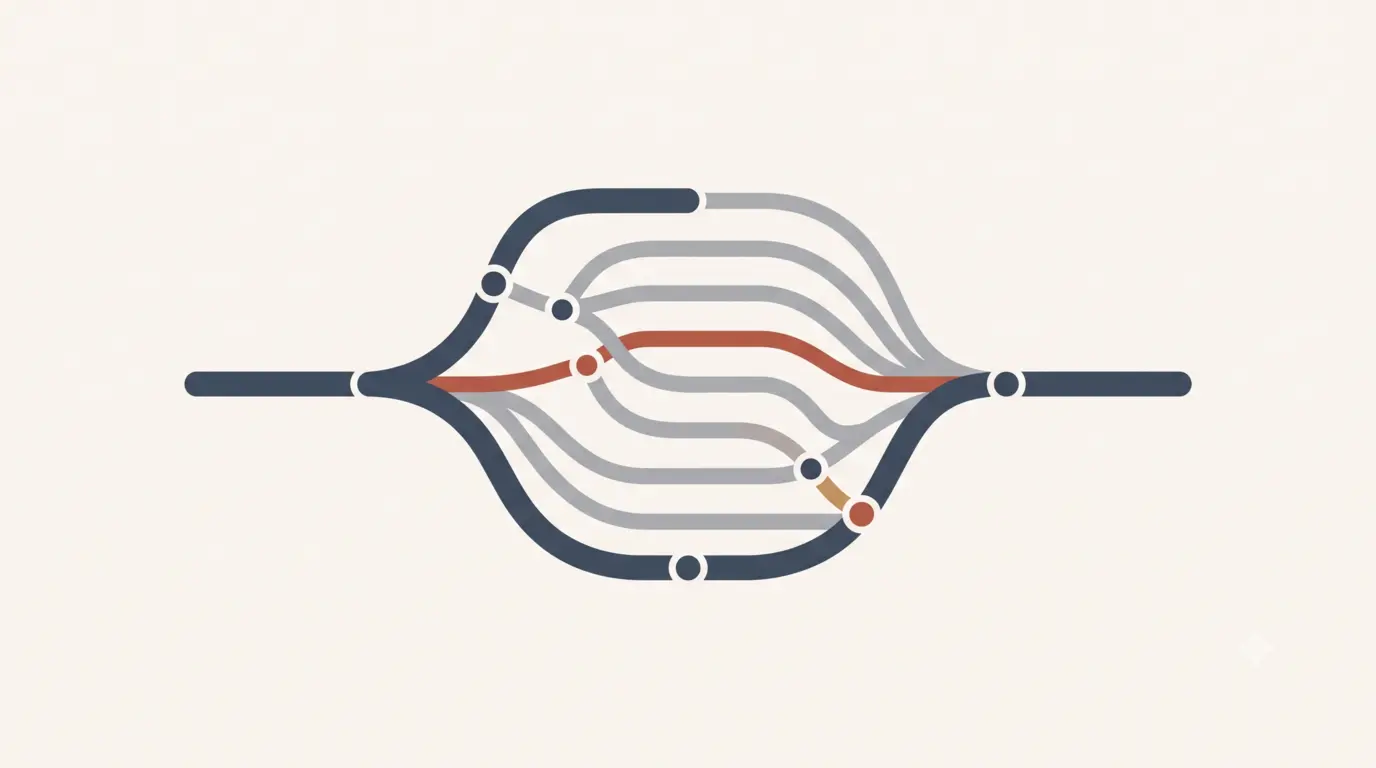
Because of the Shared Connection Model of HTTP/3.
In HTTP/3, a single QUIC connection between a browser and your edge domain is designed to be shared across all network operations for that origin:
Figure 1: The Shared HTTP/3 Connection Problem
Why Blind Tunneling Fails:
If the proxy blindly piped the client's QUIC connection to the WebTransport backend, the backend would also receive the client's GET /index.html, static images, and POST /api/v1/auth requests! Edge caching, WAF rules, CDN edge routing, and independent microservice dispatch would all be destroyed.
To proxy WebTransport correctly, a reverse proxy must:
- Terminate QUIC and HTTP/3 at the edge: Manage TLS 1.3, congestion control, and QPACK compression.
- Inspect the Extended CONNECT request: Route the session to a specific backend server based on URL path, headers, or cookies.
- Track Session IDs dynamically: Keep an in-memory routing table mapping
Session ID → Upstream Backend Instance. - Demultiplex child QUIC streams: Whenever a new QUIC stream arrives on that UDP connection, peek at its leading varint header to determine which WebTransport session it belongs to, and forward that stream to the corresponding backend!
- Demultiplex HTTP Datagrams: Inspect incoming QUIC
DATAGRAMframes, extract the quarter-stream ID, look up the session, and forward the unreliable datagram to the correct backend. - Manage Upstream Mismatches: If the backend server does not speak HTTP/3 (e.g. standard Node.js, Go, or Rust services speaking TCP or HTTP/2), the proxy must translate every QUIC stream and UDP datagram into an encapsulation protocol (such as RFC 9298: CONNECT-UDP or MASQUE capsules).
This is why proxy support is delayed. Supporting WebSockets required writing ~50 lines of code in a proxy to copy bytes between two file descriptors. Supporting WebTransport requires rewiring the proxy's core connection manager, multiplexer, routing table, flow control engine, and UDP socket dispatch loop.
The 2026 Proxy Field: Who Actually Supports What?
Here is how reverse proxies, API gateways, and cloud CDNs stack up right now:
| Proxy / Platform | HTTP/3 Support | WebTransport Proxying | Current Technical Status & Blockers |
|---|---|---|---|
| Nginx | Yes (ngx_http_v3_module) | No | Rejects :protocol = webtransport. Cannot forward HTTP Datagrams (RFC 9297) or map child streams to upstream backends. |
| HAProxy | Yes (v2.6+ through v3.x) | No | Terminates HTTP/3 request/response. Supports H2 WebSockets (RFC 8441), but lacks WebTransport session and multi-stream routing. |
| Traefik | Yes (Traefik v3) | No | Traefik's routing architecture is strictly request/response oriented. It cannot bridge HTTP/3 extended CONNECT multi-streams to backends. |
| Cloudflare CDN (Orange Cloud) | Yes (Global H3 Edge) | No (to Origins) | Edge terminates HTTP/3. Standard CDN reverse proxy drops WebTransport handshakes. Requires gray-clouding (DNS-only) to reach origins. |
| AWS ALB / CloudFront | Edge only (CloudFront) | No | CloudFront terminates HTTP/3 at edge and talks HTTP/1.1 or HTTP/2 to origins. ALB has no backend HTTP/3 support. |
| Caddy | Yes (via quic-go) | Experimental / Custom | Underlying quic-go/webtransport-go exists, but standard Caddy reverse_proxy cannot forward WebTransport upstream out of the box. |
| Envoy Proxy | Yes (Production) | Yes (Full Support) | First-class support: Downstream and upstream HTTP/3, Extended CONNECT, HTTP Datagrams, and capsule encapsulation. |
| Cloudflare Workers (workerd) | Yes | No | Inbound WebTransport API is not yet implemented in workerd; tracked as an open request in workerd issue #6451. |
Why Standard Nginx Fails to Proxy WebTransport
Many teams assume that because Nginx merged official HTTP/3 support via --with-http_v3_module, proxying WebTransport is just a matter of configuring proxy_pass. In practice, the handshake is rejected immediately:
# Attempting WebTransport in Nginx (nginx.conf)
server {
    listen 4433 quic reuseport; # HTTP/3 is active!
    ssl_certificate /etc/ssl/cert.pem;
    ssl_certificate_key /etc/ssl/key.pem;

    location /wt {
        # FATAL: Nginx rejects Extended CONNECT requests (:protocol = webtransport)
        # Nginx does not advertise SETTINGS_ENABLE_CONNECT_PROTOCOL or SETTINGS_H3_DATAGRAM.
        # It has no mechanism to demultiplex secondary QUIC streams or forward datagrams
        # to the upstream proxy_pass target.
        proxy_pass https://firefly_upstream;
        proxy_http_version 3; # Not supported upstream in standard Nginx!
    }
}
Nginx rejects the extended CONNECT method with a 405 Method Not Allowed or ignores the :protocol pseudo-header. What is worse, standard Nginx does not support HTTP/3 to upstream backends, meaning it has no way to forward raw QUIC child streams or HTTP Datagrams even if it accepted the initial handshake.
The Standout: How Envoy Makes It Work
Today, Envoy Proxy is the sole mainstream reverse proxy capable of routing WebTransport over HTTP/3 in production. Envoy's HTTP Connection Manager (HCM) was specifically upgraded with MASQUE and extended CONNECT protocol hooks:
# Envoy Proxy configuration for WebTransport over HTTP/3
static_resources:
  listeners:
  - name: udp_listener_4433
    address:
      socket_address:
        protocol: UDP
        address: 0.0.0.0
        port_value: 4433
    filter_chains:
    - transport_socket:
        name: envoy.transport_sockets.quic
        typed_config:
          "@type": type.googleapis.com/envoy.extensions.transport_sockets.quic.v3.QuicDownstreamTransport
          downstream_tls_context:
            common_tls_context:
              alpn_protocols: ["h3"]
              tls_certificates:
              - certificate_chain: { filename: "/etc/envoy/certs/cert.pem" }
                private_key: { filename: "/etc/envoy/certs/key.pem" }
      filters:
      - name: envoy.filters.network.http_connection_manager
        typed_config:
          "@type": type.googleapis.com/envoy.extensions.filters.network.http_connection_manager.v3.HttpConnectionManager
          stat_prefix: ingress_http3
          codec_type: HTTP3
          http3_protocol_options:
            allow_extended_connect: true # Enables :protocol = webtransport
          http_protocol_options:
            enable_trailers: true
          route_config:
            name: local_route
            virtual_hosts:
            - name: backend
              domains: ["*"]
              routes:
              - match:
                  prefix: "/wt"
                route:
                  cluster: firefly_webtransport_backend
                  upgrade_configs:
                  - upgrade_type: "webtransport"
                    connect_config: {}
  clusters:
  - name: firefly_webtransport_backend
    connect_timeout: 0.25s
    type: STRICT_DNS
    typed_extension_protocol_options:
      envoy.extensions.upstreams.http.v3.HttpProtocolOptions:
        "@type": type.googleapis.com/envoy.extensions.upstreams.http.v3.HttpProtocolOptions
        explicit_http_config:
          http3_protocol_options:
            allow_extended_connect: true
Notice what Envoy requires:
- A dedicated
UDPsocket listener running Envoy's QUIC transport socket (Google quiche core). codec_type: HTTP3withallow_extended_connect: true.- An upstream cluster that also speaks HTTP/3 with extended CONNECT enabled, allowing Envoy to translate downstream QUIC streams into corresponding upstream QUIC streams cleanly. Dedicated libraries like wtransport in Rust (built on quinn), Cloudflare's quiche, and AWS s2n-quic can serve as matching upstream backends.
The Cloudflare CDN Dilemma
For millions of developers, Cloudflare is the default reverse proxy and security perimeter. Cloudflare was an early pioneer of HTTP/3, yet its standard reverse proxy (the orange cloud) does not pass WebTransport sessions to origin servers.
If you want your origin server to accept WebTransport connections behind Cloudflare, you must set your DNS record to DNS-only (Gray Cloud). Doing so routes raw UDP packets directly to your origin IP address. But in exchange, you forfeit Cloudflare's DDoS mitigation, Web Application Firewall (WAF), bot management, and edge SSL termination.
For any company handling sensitive data or operating under zero-trust requirements, exposing origin IP addresses to direct UDP floods is an unacceptable tradeoff.
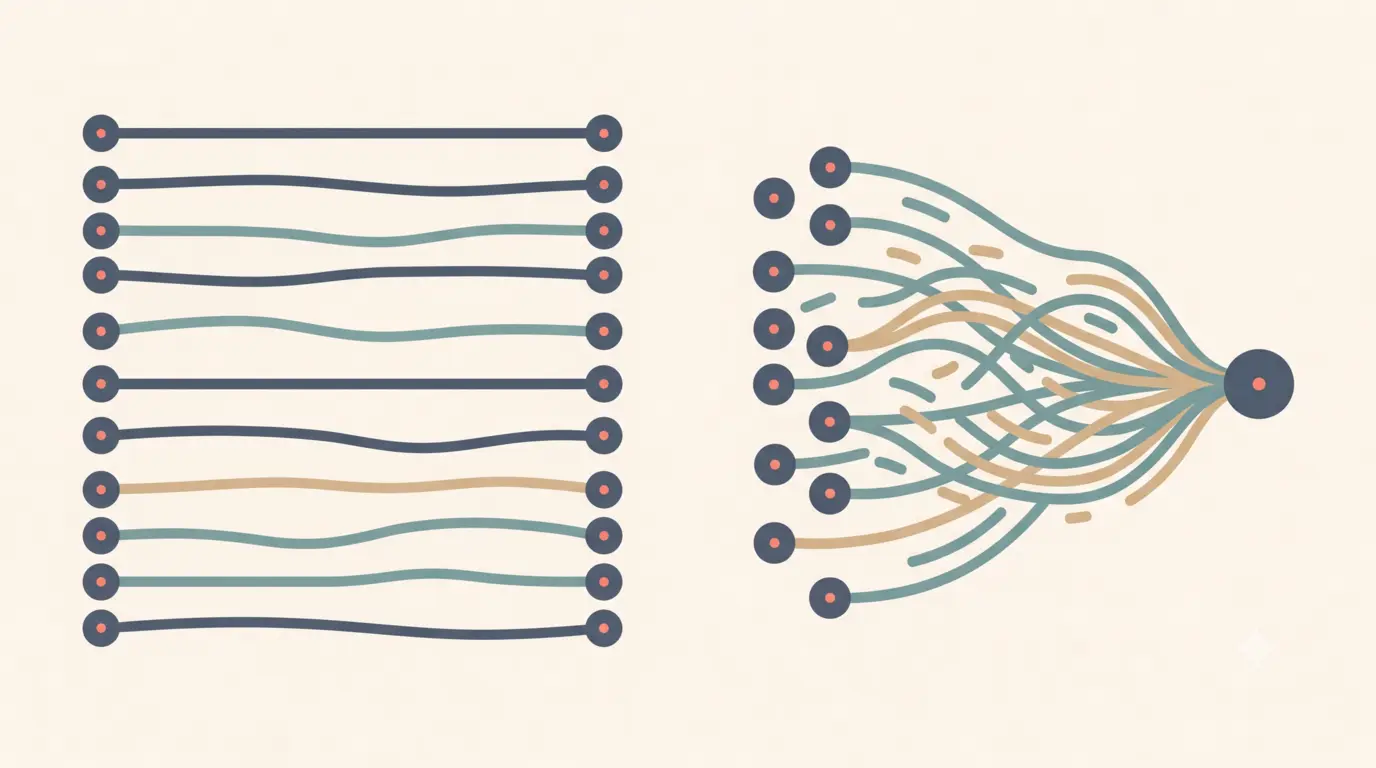
Edge-to-Origin Multiplexing: 10,000 Sockets vs. One QUIC Pipe
While reverse proxy complexity is the primary blocker today, WebTransport introduces a major architectural advantage once proxy support is solved: massive connection aggregation between the edge proxy and the origin backend.
Consider what happens in large-scale production architectures when 10,000 clients connect concurrently:
Figure 2: Edge-to-Origin Connection Topology: WebSockets vs. WebTransport
tcp_rmem + tcp_wmem)With WebSockets, every connected user requires a stateful, end-to-end TCP socket through every hop in your infrastructure. If you have an edge proxy tier and an origin application cluster, 100,000 active users mean 100,000 sockets on the edge and 100,000 sockets on the origin.
With WebTransport, the edge proxy terminates the client QUIC connection and aggregates those sessions over a single persistent upstream HTTP/3 QUIC connection to each origin instance:
- When a new client connects, the proxy simply sends an in-band
CONNECTrequest with:protocol = webtransportacross the existing upstream connection. No TCP 3-way handshake, no TLS negotiation, and no file descriptor allocation on the origin. - When the client opens bidirectional streams, the proxy forwards them as child streams on that same single upstream connection, tagged with the client's upstream
Session ID. - When the client transmits an unreliable datagram, the proxy emits an HTTP Datagram capsule frame over the same UDP 4-tuple.
This eliminates socket exhaustion, memory bloat, and connection thundering herds at the origin. It solves the hardest scale problem in real-time architecture, which makes the current lack of proxy support especially painful.
The Firefly Experience: Why We Built It, Why We Can't Deploy It
At Lupyd, we design and build Firefly, our open-source, zero-knowledge messaging engine written in Rust (github.com/lupyd/firefly).
In Firefly, low-latency, bidirectional networking is everything. Today, Firefly clients (desktop, mobile, and web) connect to Firefly server instances over a persistent WebSocket connection carrying serialized Protocol Buffers.
Over that single WebSocket pipe, Firefly does something very demanding: we multiplex dozens of concurrent, tiny request/response RPCs alongside real-time message streams:
High-Frequency Micro-RPCs
- Fetching cryptographic pre-key bundles for new contacts
- Distributing MLS (Messaging Layer Security) epoch commits
- Returning delivery and read receipts (ACKs)
- Heartbeat and presence state updates
Payload Transfers
- Encrypted multi-party chat messages
- Key packages and ratchet updates
- Inline encrypted image previews
- Voice memo chunks
Because everything shares a single WebSocket connection over TCP, we constantly fight TCP head-of-line blocking in the real world:
The Real-World WebSocket Bottleneck in Firefly:
Suppose Alice is sending a 200KB encrypted voice snippet while simultaneously receiving an urgent 40-byte MLS key rotation commit. If Alice's phone experiences momentary packet loss while stepping into an elevator or switching cell towers, the entire TCP connection freezes. The 40-byte MLS commit cannot be read by the client application until the missing TCP packet from the voice snippet is retransmitted and acknowledged.
The Architecture of Concurrent Tiny RPCs
WebTransport is the ideal architectural antidote to this problem.
To test this, we implemented full WebTransport client and server drivers inside Firefly behind a compile-time feature flag (--features webtransport):
// In Lupyd's Firefly Engine (firefly-client/src/transport/mod.rs)
// We maintain dual-transport drivers: WebSocket (default) & WebTransport (feature flag)

pub enum TransportDriver {
    WebSocket(WebSocketSession),
    #[cfg(feature = "webtransport")]
    WebTransport(WebTransportSession),
}

impl TransportDriver {
    /// Dispatches a high-frequency cryptographic RPC (e.g. key bundle fetch or delivery ACK)
    pub async fn send_rpc(&self, rpc_id: u64, payload: &[u8]) -> Result<Vec<u8>, TransportError> {
        match self {
            Self::WebSocket(ws) => {
                // Must serialize over a single TCP byte stream with sequence IDs.
                // If a packet drops on bad Wi-Fi, ALL pending RPCs stall behind it!
                ws.dispatch_multiplexed_frame(rpc_id, payload).await
            }
            #[cfg(feature = "webtransport")]
            Self::WebTransport(wt) => {
                // Spawns a dedicated bidirectional QUIC stream for this specific RPC.
                // Zero head-of-line blocking: Packet loss on this stream does not delay other RPCs.
                let mut stream = wt.open_bi().await?;
                stream.write_all(payload).await?;
                stream.finish().await?;
                let response = stream.read_to_end().await?;
                Ok(response)
            }
        }
    }

    /// Emits an ephemeral typing or presence indicator
    pub async fn send_presence(&self, indicator: &[u8]) -> Result<(), TransportError> {
        match self {
            Self::WebSocket(ws) => {
                // Forced to send reliably over TCP, wasting buffers and bandwidth on stale state
                ws.send_text(indicator).await
            }
            #[cfg(feature = "webtransport")]
            Self::WebTransport(wt) => {
                // Fires an unreliable, congestion-controlled HTTP Datagram
                wt.send_datagram(indicator).await
            }
        }
    }
}
Under this model, the architectural transformation is immediate:
- Independent RPC Streams: Every time Firefly needs to fetch a pre-key bundle or send an ACK, it calls
wt.open_bi(). The RPC executes on its own QUIC stream. If that stream loses a packet, only that individual RPC is delayed. Every other chat message and background sync operation continues without a microsecond of pause. - Ephemeral Presence over Datagrams: Typing indicators and cursor positions are pushed over
wt.send_datagram(). If a typing indicator is dropped on a jittery link, who cares? The next one arrives 200ms later anyway. No TCP buffers are wasted, and no retransmissions clog the radio interface.
Why We Keep WebTransport Behind a Flag in Firefly
Our local integration tests and internal container benchmarks show dramatic latency improvements over lossy networks. We documented the complete telemetry and data from our 1,500-endpoint test in our companion post: WebTransport vs. WebSocket: A Real-World Benchmark Under Impaired Networks, measuring an 80.2% reduction in tail latency under cellular packet loss. But we cannot deploy WebTransport to our production users today. Our edge proxies and CDN infrastructure do not support routing WebTransport sessions to our backend pools. We refuse to expose our database and messaging origins to the naked internet without DDoS scrubbers and reverse-proxy firewalls.
The code is written. The browser support is there. The performance gains are verified. But until our edge infrastructure catches up, WebTransport remains dormant behind a feature flag.
What Needs to Happen for WebTransport to Succeed
For WebTransport to break through the reverse proxy impasse and replace WebSockets as the default web transport, three things must happen across the infrastructure ecosystem:
1. Upstream HTTP/3 in Nginx & HAProxy
Nginx and HAProxy must expand HTTP/3 beyond edge termination to support upstream HTTP/3 with Extended CONNECT. Maintainers must adopt capsule routing to demultiplex child streams to application pools.
2. Managed CDN Origin Proxying
Cloudflare, Fastly, and AWS CloudFront must enable WebTransport origin tunneling through their protected CDN networks, allowing applications to use WebTransport without stripping off WAF and DDoS shields.
3. Standardized Fallback Patterns
Client libraries must standardize transparent dual-stack handshakes: attempt WebTransport over HTTP/3 with a strict 1-second timeout, falling back seamlessly to WebSockets over TCP when UDP is filtered or proxies reject the handshake.
Until then, developers should follow the same pattern we use in Firefly: design your wire protocol (like Protobuf or binary frames) so that it is transport-agnostic. Separate your message serialization from your transport driver. When reverse proxy support finally matures, flipping from WebSockets to WebTransport will take a single configuration change rather than an architectural rewrite.
Frequently Asked Questions
Is WebTransport just WebSocket 2.0 or an upgrade over QUIC?
No. WebTransport is not an HTTP upgrade header or a WebSocket version. It is an independent transport framework defined by the IETF (draft-ietf-webtrans-overview) that exposes multiple unidirectional and bidirectional streams and datagrams. While RFC 9220 defines WebSockets over HTTP/3, WebTransport is a completely separate protocol capable of running over HTTP/3, HTTP/2, raw QUIC, or even WebSockets.
Which browsers support WebTransport?
WebTransport enjoys near-universal modern browser support. Google Chrome, Microsoft Edge, and Chromium-based browsers have supported it since version 97. Mozilla Firefox enabled it in version 114. Apple Safari / WebKit enabled WebTransport over HTTP/3 by default starting with Safari 17.4 across macOS and iOS.
Why don't Nginx, HAProxy, and Traefik support WebTransport proxying?
WebTransport sessions don't send all data over the initial HTTP/3 CONNECT stream. Instead, WebTransport delegates stream creation to the underlying QUIC connection, creating separate streams and UDP datagrams identified by session IDs on the same 4-tuple. What is more, HTTP/3 connections are shared between WebTransport and regular web requests. Supporting this requires reverse proxies to demultiplex dynamic QUIC streams, map session IDs to backend routes, and manage flow control across connections, requiring architectural rewrites of their connection dispatch engines.
Which reverse proxies currently support WebTransport?
Envoy Proxy is the primary production reverse proxy that supports WebTransport over HTTP/3 with downstream and upstream extended CONNECT, HTTP Datagrams (RFC 9297), and capsule routing. Native application servers can be built using libraries like wtransport (Rust) and quic-go/webtransport-go, while edge runtimes like Cloudflare Workers do not yet support inbound WebTransport (workerd issue #6451).
How does WebTransport aggregate connections between edge proxies and origins?
WebSockets require a dedicated 1:1 upstream TCP connection per connected client. WebTransport, by contrast, lets an edge proxy terminate thousands of client QUIC connections and multiplex all of them over a single upstream persistent HTTP/3 connection to the origin server. Each client session is mapped in-band to an upstream Session ID, shrinking origin file descriptor and kernel buffer overhead by over 98%.
Why does Lupyd's Firefly engine support WebTransport only behind a flag?
Firefly benefits enormously from WebTransport because it multiplexes dozens of concurrent tiny request/response RPCs (such as key distribution, delivery ACKs, and MLS commits) that currently suffer from TCP head-of-line blocking over WebSockets. However, because enterprise CDN and edge proxy infrastructure (such as Cloudflare's standard reverse proxy) cannot route WebTransport sessions to backend origins, Lupyd keeps WebTransport behind a feature flag until production proxying is viable.
- ✓ WebTransport is not a WebSocket upgrade: it is an independent transport framework capable of running over HTTP/3, HTTP/2, raw QUIC, or WebSockets.
- ✓ All three major browser engines support WebTransport in 2026: Chromium shipped it in v97, Firefox in v114, and Safari enabled it by default in 17.4.
- ✓ Unlike WebSockets' single byte stream, WebTransport provides native unidirectional streams, bidirectional streams, and unreliable datagrams with QUIC congestion control.
- ✓ WebTransport streams do not originate within the CONNECT session; WebTransport asks the underlying QUIC protocol to spawn new streams that share the same connection.
- ✓ Because HTTP/3 connections are shared between normal web requests and WebTransport, proxies cannot blindly tunnel connections without breaking HTTP routing and caching.
- ✓ WebTransport unlocks massive server-side efficiency: edge proxies can multiplex thousands of client sessions over ONE upstream QUIC connection to origins, replacing WebSockets' 1:1 TCP socket proliferation.
- ✓ Reverse proxy support is the bottleneck: Nginx, HAProxy, Traefik, and Cloudflare CDN do not proxy WebTransport to origins; only Envoy supports it in production today.
- ✓ Lupyd's Firefly messaging engine supports WebTransport behind a feature flag for concurrent tiny RPCs, but runs WebSockets in production due to lack of proxy support.