WhatsApp is used by more than two billion people and is the default chat app for most Indian professionals. It is end-to-end encrypted. But “encrypted” does not mean “safe for client work.” Backups bypass encryption, Meta holds your metadata, your firm cannot control data on employees’ personal phones, and there is no separation between personal and client conversations.
This guide explains exactly what WhatsApp protects, where the gaps are, and what CA firms, law firms and businesses should do about it.
Is WhatsApp End-to-End Encrypted?
Yes, with important limits. WhatsApp uses the Signal Protocol to encrypt messages between sender and receiver. In a correctly functioning WhatsApp conversation, neither WhatsApp nor Meta can read the message content. That part of the story is true and technically strong.
- ✓ Message content in transit between devices
- ✓ Voice and video calls (E2EE)
- ✓ Files and photos shared in the chat (in transit)
- ✓ Messages cannot be read by WhatsApp's servers
- × Cloud backups (Google Drive / iCloud): not E2EE by default
- × Metadata: who you talk to, when, how often
- × Data on an employee’s personal phone when they leave
- × Business API messages flowing through third-party providers
The Backup Problem: Where E2EE Breaks Down
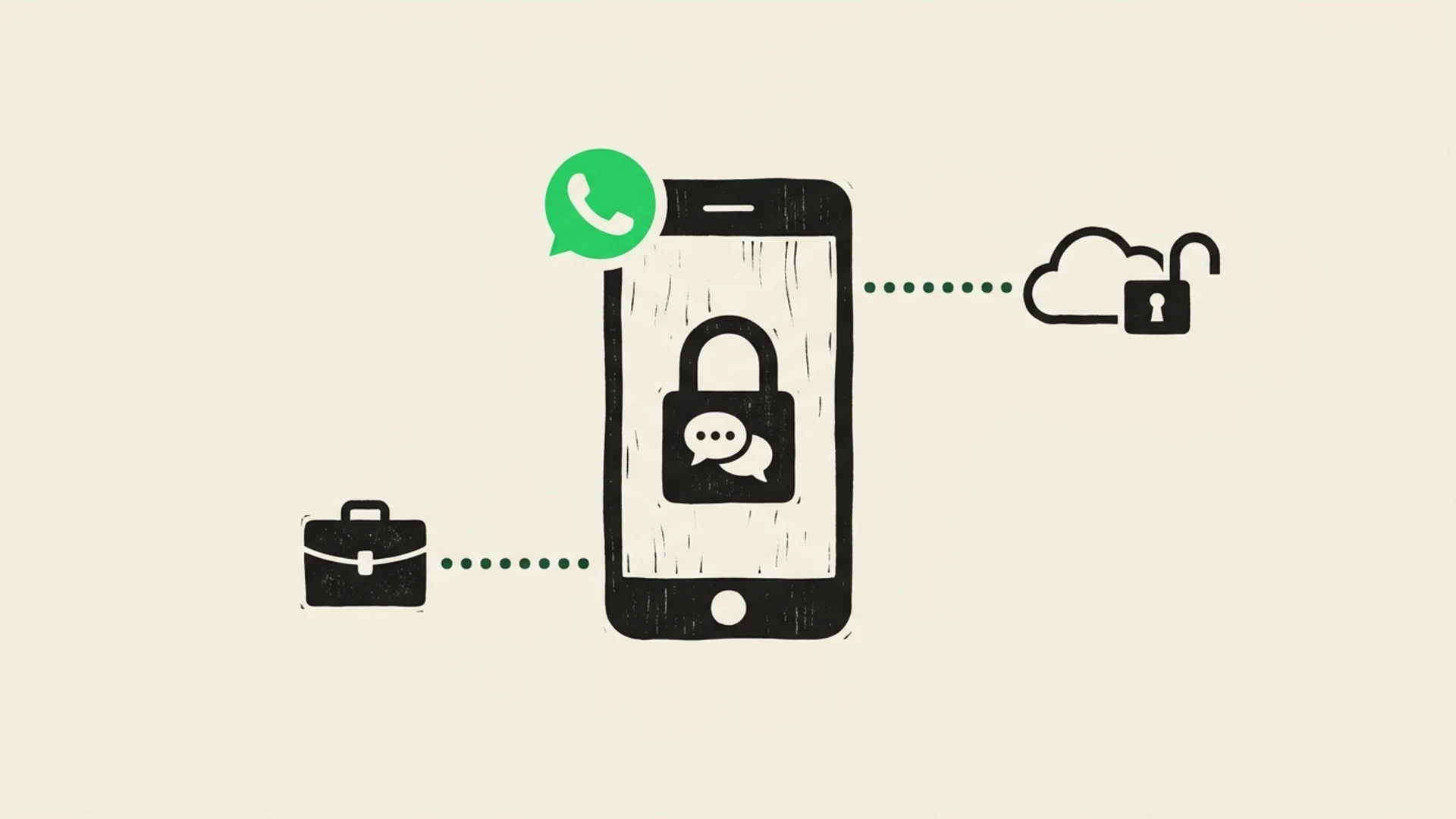
This is the most overlooked risk. When a WhatsApp user backs up to Google Drive or iCloud, those backups are stored on cloud servers outside WhatsApp’s E2EE envelope. Google and Apple can access them. Law enforcement can subpoena them. If either cloud account is compromised, the entire chat history is exposed.
| Backup type | Who can access it? | E2EE? |
|---|---|---|
| Google Drive backup (default) | Google, law enforcement, anyone with Google account access | No |
| iCloud backup (default) | Apple, law enforcement, anyone with Apple ID access | No |
| WhatsApp E2EE backup (opt-in) | Only the device owner with the encryption key | Yes: if enabled |
| No backup | Only the device itself | Yes: but lost if phone is lost |
Metadata: What Meta Can See Even Without Reading Messages
Even when message content is encrypted, WhatsApp collects and shares with Meta:
For a law firm, the metadata showing that Partner A spoke to Client B for 45 minutes on the day before a court filing is itself sensitive information, even if nobody can read what was said. For a CA firm, patterns of communication with a client around tax deadlines reveal business activity. Metadata is not trivial.
The Personal Phone Problem for Businesses
This is the biggest operational risk for professional firms. When staff use personal WhatsApp accounts for client work:
No Admin Control
The firm cannot remotely wipe, audit or manage conversations on a personal device. There is no IT policy that can reach inside a personal WhatsApp account.
Data Leaves With the Employee
When a staff member or article leaves, they take the full client chat history with them. Client PAN details, case strategy, and financial records sit on their personal phone, with no way for the firm to delete or recover them. See our employee offboarding guide for the full picture.
Personal and Client Conversations Mix
There is no separation. A screenshot sent to the wrong contact, a phone left unlocked, or a phone stolen exposes both personal and client data together.
Personal Cloud Backups Include Client Data
Many employees back up phones to personal Google or iCloud accounts. Work files and chats then exist in a personal account the company cannot control, sometimes without encryption. When the employee leaves, so does that copy.
WhatsApp Personal vs WhatsApp Business vs Business API
| Version | E2EE messages? | Admin control? | Who holds keys? |
|---|---|---|---|
| WhatsApp Personal | Yes (devices) | No | Device endpoints |
| WhatsApp Business App | Yes (devices) | No | Device endpoints |
| WhatsApp Business API | Partially: depends on BSP | Some controls | Meta + third-party BSP |
The WhatsApp Business API routes messages through Business Solution Providers (BSPs), which are third-party companies. Those BSPs can read message content, and many store it on their own servers. Before using the API, you need to know exactly which BSP handles your messages and what their data retention and encryption policies are.
Risks for CA Firms, Law Firms and Indian Businesses
Under India’s Digital Personal Data Protection Act, 2023 and the DPDP Rules, 2025, your firm is the Data Fiduciary for client personal data. You cannot outsource that liability to WhatsApp or Meta. If client data shared via WhatsApp leaks through a compromised backup, a lost phone, or a departing employee, the enforcement action falls on your firm.
CA Firms
PAN, Aadhaar, bank statements, ITR acknowledgements, GST credentials and financial statements are routinely shared over WhatsApp with clients and articles. Each of these is personal data under the DPDP Act.
Law Firms and Advocates
Privileged client communications, case strategy, draft filings and settlement figures discussed on WhatsApp sit outside any professional secrecy framework the moment they reside on Meta’s metadata servers or an uncontrolled employee backup.
Businesses and Startups
Salary slips, investor term sheets, HR complaints and vendor contracts shared on WhatsApp create data trails that the firm does not fully control and cannot audit.
What to Do Instead: A Practical Split
You do not need to ban WhatsApp entirely. A practical split protects client data without disrupting everyday communication:
- ✓ Scheduling calls and meetings
- ✓ Quick status updates and reminders
- ✓ Informal coordination with clients who only use WhatsApp
- ✓ Non-sensitive acknowledgements
- × PAN, Aadhaar and government ID numbers
- × Bank statements and financial documents
- × Case strategy and legal advice
- × Salary, HR and investor information
- × Passwords, OTPs and access credentials
How Lupyd Helps
Lupyd is an end-to-end encrypted team workspace built in India for professional firms. It solves every gap that WhatsApp leaves open for business use:
| What your firm needs | Lupyd | |
|---|---|---|
| E2EE messages by default | Yes (device only) | Yes (device only) |
| E2EE encrypted backups | Opt-in only | Yes, by default |
| Admin-controlled workspace | No | Yes |
| Revoke access when staff leave | No | Yes: instantly |
| Separate personal and work data | No | Yes: workspace isolation |
| Encrypted file sharing | E2EE in transit only | E2EE end-to-end |
| No metadata collection | No: Meta collects metadata | Yes: no tracking |
| Built for Indian professional firms | No | Yes |
Encrypted by default. Signal Protocol for DMs, MLS for group channels, and AES for files: each encrypted on your device before leaving it.
Admin control. Revoke access the moment someone leaves. Roles and permissions ensure staff only see the client channels they work on.
No metadata collected. No ads, no tracking, no behavioral telemetry on your team’s activity.
Private search. Full-text search runs on your device, so search terms never reach a server.
Try Lupyd and move your sensitive client conversations to a workspace where the provider cannot read them.
Frequently Asked Questions
Is WhatsApp safe for sending PAN and Aadhaar documents?
The content is encrypted in transit, but it is stored on the recipient’s uncontrolled personal device, may be backed up to an unencrypted cloud account, and you have no way to delete or audit it later. For regulated personal data, use an admin-controlled E2EE platform.
Can Meta read my WhatsApp messages?
Meta cannot read the content of messages in transit, but it collects extensive metadata. Backups stored in Google Drive or iCloud without the optional E2EE backup feature are not end-to-end encrypted and can be accessed by the cloud provider.
Is WhatsApp Business safer than WhatsApp Personal?
WhatsApp Business uses the same encryption as WhatsApp Personal, so the protection is identical for direct messages. The Business API introduces additional risk because messages may pass through a third-party Business Solution Provider.
What happens to client data when a WhatsApp employee leaves?
They take it with them on their personal phone. The firm has no way to remotely delete WhatsApp chats, revoke access, or audit what conversations they retain. This is the core problem with using personal chat apps for client work.
Does WhatsApp comply with India’s DPDP Act?
Compliance depends on how you use it. WhatsApp can be a compliant communication channel for informal coordination, but using it to transfer, store and process client personal data without appropriate safeguards creates liability for your firm as the Data Fiduciary.
What is a safer alternative to WhatsApp for business?
An end-to-end encrypted workspace with admin controls (such as Lupyd) gives you E2EE messages and files, the ability to revoke access instantly, workspace isolation between clients, and no personal-phone data leakage.
The Bottom Line
WhatsApp’s encryption is real and technically sound for personal messaging. But it was designed for individuals, not for firms that handle regulated client data. The backup gaps, the metadata collection, the lack of admin control and the inability to recover data from a departing employee’s phone make it a poor fit for professional client communication.
Use WhatsApp for scheduling and informal updates. Use an E2EE workspace with admin controls for anything involving client identity, financials, legal strategy or confidential files.
Try Lupyd and give your team a secure space for the work that matters most.
Secure Client Communication for Law Firms and CA Firms • Is Google Chat End-to-End Encrypted? • Is Telegram Really End-to-End Encrypted? • How to Offboard Employees Without Leaking Client Data
Last updated: 29 October 2026. This article is general information and not legal advice. WhatsApp’s product features and encryption policies may change; verify details with primary sources.
- ✓ WhatsApp uses the Signal Protocol for transit E2EE, but cloud backups (Google Drive / iCloud) are unencrypted by default and accessible to providers.
- ✓ Meta collects extensive communication metadata: timestamps, phone numbers, location hints, and interaction graphs.
- ✓ When employees leave a firm, client chats, confidential financial records, and PAN cards remain stored on their personal devices.
- ✓ The WhatsApp Business API introduces third-party solution providers (BSPs) that can access unencrypted message payloads.
- ✓ A safe operational model separates informal coordination on WhatsApp from sensitive client records and files stored in a dedicated E2EE workspace.
The workspace where nothing leaks
End-to-end encrypted channels and chat for your team, built on the Signal Protocol and MLS. Available on macOS, Windows, Linux and Android.